


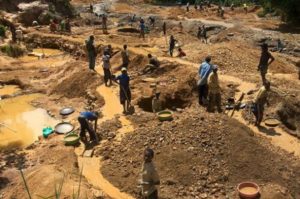
Accra, Ghana//-The Commonwealth Human Rights Initiative (CHRI) Africa Office today called on the Government of Ghana to expedite the repeal of Legislative Instrument (L.I.) 2462, which regulates mining activities in forest reserves.
This, according to the NGO, would help to protect the country’s remaining forest reserves and natural resources from the nefarious activities of illegal mining, popularly known in Ghana as galamsey.
The CHRI made the call in a statement to mark the International Human Rights Day 2025, which is celebrated under the theme ‘Human Rights: Our Everyday Essentials’.
Recently, however, Ghana’s Acting Minister for Environment, Science, Technology, and Innovation, Emmanuel Armah-Kofi Buah, requested the Attorney General to expedite the revocation of L.I.2462.
The request was officially communicated through a statement by the Ministry dated August 29, 2025. The controversial L.I. 2462 permitted mining in forest reserves, despite environmental concerns and calls for its repeal.
Issued under the Minerals and Mining Act, it allowed for mining activities, including small-scale mining, in forest areas that were previously protected. It also granted the President authority to grant mining licenses in forest reserves.
This move is aligned with the government’s commitment to addressing environmental concerns and restoring the integrity of Ghana’s forest reserves.
L.I. 2462 has faced criticism from various environmental groups and stakeholders who argue that it facilitates unsustainable mining practices in protected areas.
The repeal aims to reinforce the Environmental Protection Agency’s (EPA) authority to regulate and monitor activities within these reserves effectively.
The Ministry is looking to replace it with an amended version L.I 2501.
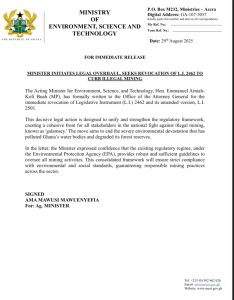
The statement issued by the Ministry
The government’s call for the revocation underscores the administration’s dedication to sustainable environmental management and the protection of Ghana’s natural resources.
The new legislation, when passed, would revoke the President’s authority to grant mining licenses in forest reserves, a move widely seen as a critical step in tackling illegal small-scale mining.
More demands
The CHRI is also asking the Ghanaian government to implement the recent recommendations of the African Commission on Human and Peoples’ Rights (ACHPR), including establishing an independent, high-level investigation into the illegal mining network in the country.
“This investigation must expose and hold accountable the political, economic, and criminal actors sustaining the practice, supported by anti-corruption safeguards, transparency, and full public reporting”, the human rights NGO said in the statement issued in Accra.
It noted that food security continues to worsen as climate change, land degradation, and galamsey destroy arable lands and undermine sustainable agriculture.
Livelihood losses, particularly among farmers, fishers, women, and rural households, have become a serious human rights concern, with pollution and unsafe working conditions pushing vulnerable communities further into poverty.
The destruction of forests, wetlands, and farmlands continues to intensify climate risks and jeopardise the rights of present and future generations to a safe and healthy environment.
These realities affirm that human rights are intimately tied to the essentials that sustain life and livelihoods, the NGO further stated.
When rivers are polluted, when fertile lands are destroyed, when communities lose their income sources, when information is withheld, and when justice becomes inaccessible, the fundamental rights of individuals and communities are violated.
Protecting everyday essentials is therefore not merely an environmental or development concern—it is a human rights imperative.
Across Africa, similar threats persist as climate-induced food insecurity, water stress, shrinking civic space, weak governance, and conflict undermine rights and livelihoods.
From the Sahel to the Horn of Africa, millions face droughts, floods, insecurity, and economic instability.
Weak environmental enforcement, corruption, and limited access to justice continue to erode public trust and stall progress toward inclusive development.
Furthermore, fundamental rights such as access to information, justice, education, healthcare, food, clean water, a healthy environment, personal security, and inclusive governance form the foundation on which individuals depend each day.
However, these everyday rights are increasingly under threat in Ghana and Africa in general.
Safeguarding Everyday Human Rights
To safeguard these everyday human rights and restore confidence in public institutions, the CHRI urged governments across Africa to: · Strengthen environmental protection and invest in climate resilience. · Enforce laws against illegal mining, pollution, and deforestation, supported by transparent natural resource governance. · Expand access to justice, particularly for vulnerable and rural communities. · Guarantee the right to information through proactive disclosure and transparency.
It also urged all the governments across Africa to integrate human rights into national development planning and budgeting, and enhance regional cooperation on climate change, migration, environmental protection, and human rights reporting.
As the world marks Human Rights Day 2025, CHRI Africa Office calls on leaders, institutions, and citizens to reaffirm their commitment to the rights that safeguard everyday essentials.
Only by upholding these rights can Africa build just, resilient, and inclusive societies where every individual lives in dignity and reaches their full potential.
This year’s theme underscores that human rights are not distant principles but essential safeguards that anchor our daily lives—guaranteeing safety, dignity, equality, and freedom.
Instructively, International Human Rights Day is observed annually on 10th December and marks the adoption of the Universal Declaration of Human Rights (UDHR) in 1948—a landmark document affirming the inalienable rights of every individual.
