

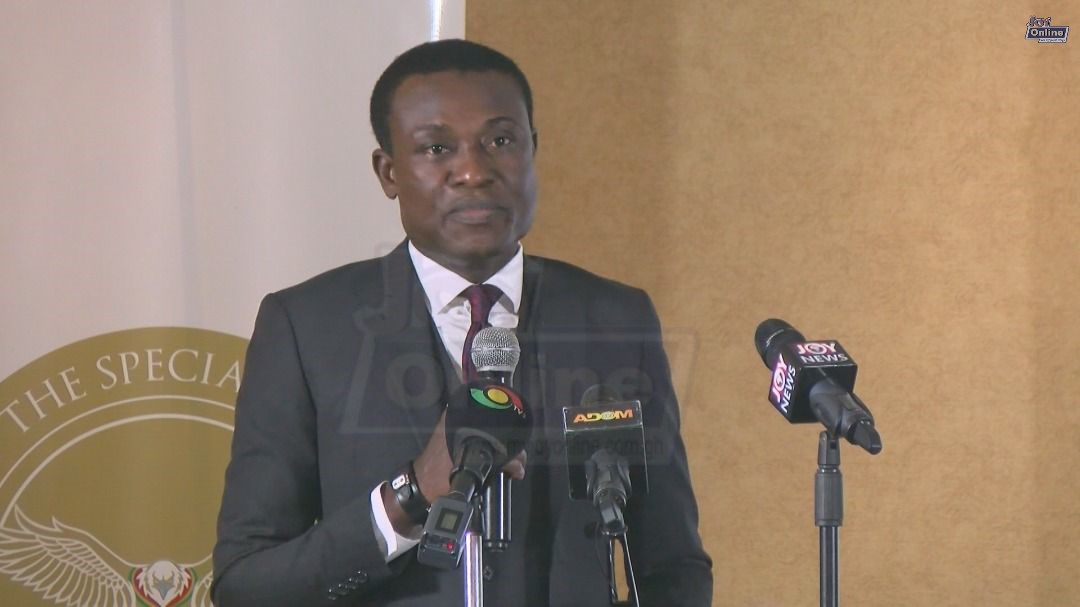

Accra, Ghana//-The creation of the Office of the Special Prosecutor (OSP) stands as a monument to political courage, a singular act by President Nana Addo Dankwa Akufo-Addo that laid the bedrock for a specialised, independent anti-corruption architecture.
It is a legacy defined not by personalities but by the establishment of a necessary institution.
We must concede the essential truth: despite the controversies surrounding its occupants and the attendant political friction, the OSP remains Ghana’s most independent prosecutorial body in the existential fight against corruption. This appreciation is not an endorsement of performance, but a clarification of principle.
The distinction between the OSP and other oversight bodies is a chasm defined by the power to prosecute. CHRAJ, a constitutional guardian, is limited to making findings and recommendations; it is an investigative and adjudicative body, not an enforcement arm.
The OSP, by contrast, is a precision tool carved from the state’s legal armoury: it possesses full police powers, the mandate to freeze and confiscate assets, and, most critically, the unconstrained power to charge and argue cases in court. This is the sovereignty of prosecution, the very autonomy that allows it to operate outside the traditional, politically tainted chain of command.
The OSP’s creation, crystallised in the Office of the Special Prosecutor Act, 2017 (Act 959), was a direct response to a glaring structural failure.
Before 2017, the power to prosecute all crimes resided solely with the Attorney-General (AG), a cabinet-level political appointee. This arrangement suffered from an inherent conflict of interest, leading to a long history of high-level corruption cases being stifled. The OSP was designed to sever this political umbilical cord, granting a dedicated institution the authority to operate without being subjected to the “direction or control of any person or authority.”
Yet, this statutory independence is constantly tested by two towering forces: constitutional hierarchy and political resistance. The OSP is a legal paradox: independent by statute, yet constitutionally subordinate.
The AG, by virtue of Article 88 of the Constitution, retains the ultimate constitutional right to assume or discontinue any criminal prosecution. This provision casts a perpetual shadow of executive interference over the OSP, making its authority only as secure as the political goodwill of the sitting government.
This structural conflict means the moment a case strikes too close to the heart of the administration, the constitutional override becomes a looming, existential threat.
The AG’s power is the most potent weapon political actors possess to derail the anti-corruption drive.
Furthermore, the pursuit of high-profile cases involving politically exposed persons is not met with cooperation, but with active resistance, legal sabotage, and resource starvation.
This has been starkly evidenced in critical case files: The Agyapa Royalties Transaction, where the OSP’s strong Corruption Risk Assessment led to direct clashes and contributed to the resignation of the first Special Prosecutor, Martin Amidu citing interference.
The Labianca Company/CEPS Case, where the OSP’s findings on revenue malpractices demonstrated its willingness to target private sector complicity.
And the Cecilia Dapaah Case, which provided a high-stakes example of the OSP’s use of its asset-freezing powers, only to face jurisdictional and procedural challenges from the courts and other state agencies.
An inadequately funded, poorly staffed OSP is an impotent OSP. Independence must be operational, not just ornamental. Fighting sophisticated financial crime requires competitive compensation for specialised forensic talent, not bureaucratic delay.
When the OSP operates with a fraction of its required budget, its ability to execute its mandate, including complex international asset tracing, is compromised.
This deliberate financial attrition serves as a passive but highly effective method of political interference.
The argument is clear: we must distinguish the Office from the Officeholder. The OSP is a systemic answer to a systemic problem, the failure of the traditional anti-graft bodies to prosecute the “big fish.” This architecture is necessary.
To weaken or dismiss the OSP based on political dissatisfaction is to commit a grave tactical error, sending a signal that political attrition is a viable strategy against institutional accountability.
The path to an effective anti-corruption regime is not paved with resignations, but with resolution. Anti-Corruption stakeholders must rally behind the institution by demanding unfettered resource allocation and initiating a reasoned debate on how to legally ring-fence the OSP’s prosecutorial independence from the AG’s constitutional override in corruption cases, without undermining the entire prosecutorial framework.
The OSP is not the end of the fight; it is the beginning of a new chapter. Its survival, strength, and success are not merely political desires; they are a constitutional and moral imperative. We have built the sanctuary; now we must defend its walls and empower its guard.
By Raymond Ablorh, Policy, Research, Media and Strategic Communication Consultant
