

More than 2 billion people, many of whom live in Sub-Saharan Africa, still lack access to clean cooking fuels and technologies. This lack of access has huge implications for health, gender equality, and the environment.[1]
The cost of inaction is staggering – estimated at USD 330 billion annually in Sub-Saharan Africa alone.[2] Smoke from traditional cooking stoves drives illness, limits families’ time and income, and damages the environment. Children are the most vulnerable – exposure to household air pollution during a child’s early years undermines growth and development. Adults face reduced productivity, lower wages, and overall lower quality of life.
The new World Bank USD 200 million Clean Cooking Outcome Bond complements global efforts to address these issues. The bond mobilises private capital to support clean cooking projects in Ghana.
“We are proud to catalyse private investment to deliver clean cooking to 1.3 million people in Ghana. By linking returns to verified ITMOs, this outcome bond advances access to carbon markets, supports local manufacturing, and delivers measurable climate and health gains.
We are committed to supporting our clients, including in mobilising private capital, to bridge financing gaps, de-risk investments, and bring climate-smart technologies to communities faster,” Robert Taliercio O’Brien, Division Director for Ghana, Liberia, and Sierra Leone, World Bank, said.

ITMOs are units representing verified greenhouse gas emission reductions that can be transferred internationally between countries or jurisdictions. This mechanism enables countries to cooperate on climate goals by trading emission reductions.
This arrangement mitigates the risk of double-counting carbon credits and unlocks a higher global impact than isolated domestic efforts. By monetising these reductions, ITMOs provide a financial incentive for projects that deliver measurable climate benefits.
UpEnergy will receive disbursements of the front-loaded amounts from SCB, subject to achieving pre-agreed project milestones. Carbon credits in the form of ITMOs are generated by the UpEnergy projects through the use of cleaner cookstoves. KliK Foundation in Switzerland has committed to purchase these ITMOs under an offtake agreement.
By integrating ITMOs into the bond structure, the World Bank demonstrates that carbon markets and innovative finance can converge to deliver health, economic, and environmental benefits at scale.
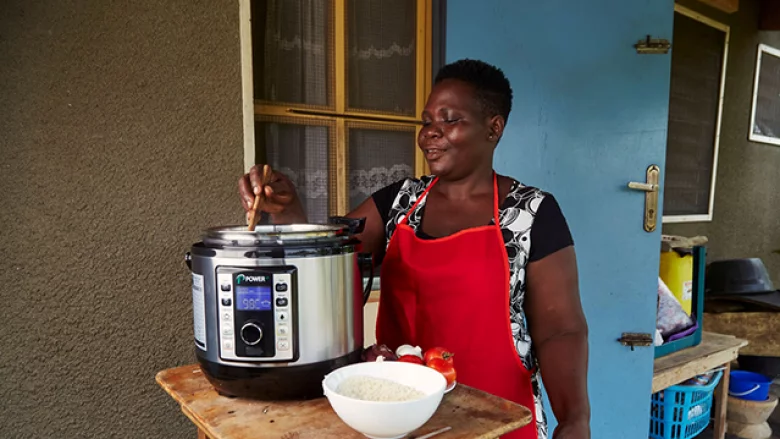
Implemented by UpEnergy, the projects aim to expand access to energy-efficient Improved Charcoal Stoves (ICS) and Electric Cookstoves (ECs) for residential households in Ghana.
This initiative aims to make clean cooking accessible to 1.3 million people, decreasing reliance on biomass use and lowering greenhouse gas emissions. By distributing a mix of modern electric cooking systems for grid-connected households and efficient biomass stoves for those reliant on charcoal and other solid fuels, the projects provide households with cleaner cooking technology while addressing critical environmental and health challenges.
The use of cleaner cookstoves is expected to reduce household fuel costs, improve indoor air quality, reduce emissions, and help prevent deforestation. The projects will provide additional co-benefits, such as the creation of local job opportunities and saving households time, which will allow women in particular to engage in other social and professional activities.
“For us, this is about what’s possible when climate finance is tied directly to real outcomes in people’s homes,” said Mitch Sauers, CEO of UpEnergy. “By pairing outcome-based finance with Article 6, we can expand access to reliable, culturally aligned electric cooking technologies while strengthening local supply chains and reducing reliance on charcoal.
We’re grateful to Ghana and Switzerland for their leadership, and to the World Bank and Standard Chartered for structuring a model that channels private capital into climate and household-level benefits.”
The outcome bond offers investors potential enhanced yields over regular World Bank issuances of similar maturity, if the projects perform as expected. By channelling private capital to projects with measurable climate outcomes, the Clean Cooking Outcome Bond illustrates how carbon markets combined with creative financing structures can accelerate progress toward universal access to clean cooking.
