

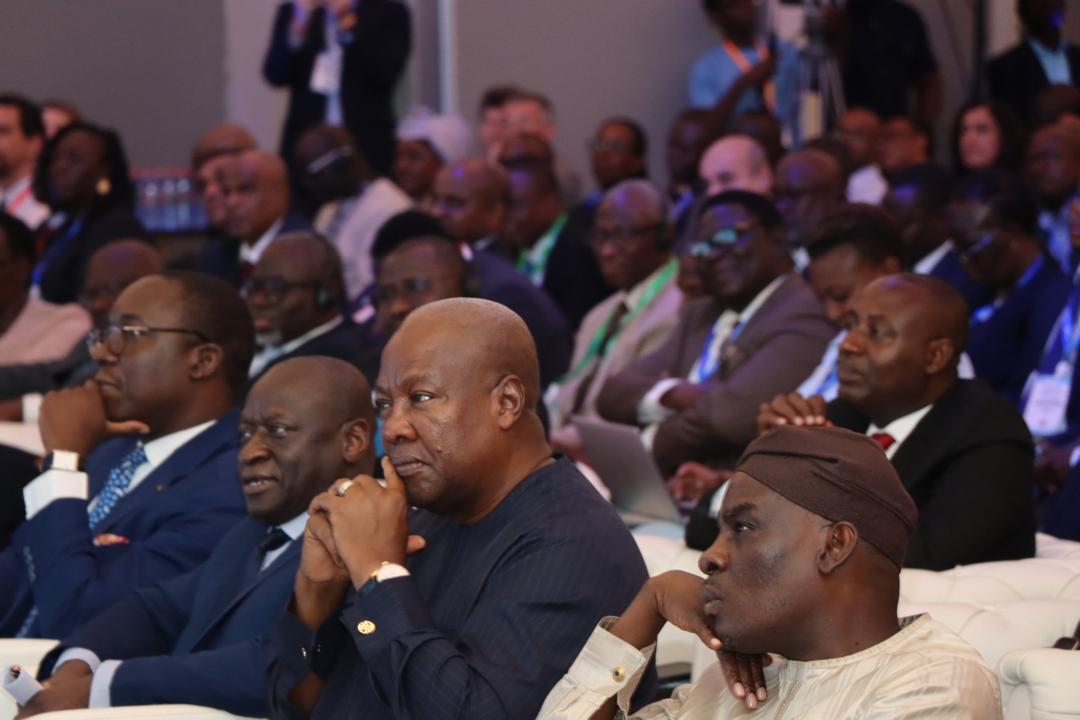

Accra, Ghana//-Ghana’s President John Dramani Mahama today called for greater investment in higher education in Africa to enable the various African countries to harness the power of research, innovation, and strategic partnerships to drive the continent’s socio-economic development.
He made the call at the opening ceremony of the three-day forum to mark the 10th anniversary of the Africa Higher Education Centers of Excellence (ACEs) in Accra.
The event which began from April 7 to 9, for a three-day celebration marking the 10th anniversary of the ACE program, a transformative journey in Africa’s higher education was attended by about 500 participants.
They included more than 80 ACEs, policymakers, higher education leaders, industry experts, and development partners.
Mr Mahama acknowledged that the ACE program stands at the forefront of Africa’s efforts to create a knowledge-based economy and bridge critical skills gaps in emerging sectors.
“The prospects for the ACE program are very bright. With sustained support from governments, donors and the private sector, these centres can scale up their impact, deepen regional cooperation, and lead Africa’s charge toward a knowledge-based future”, he told the participants.
He added: “The ACE Program has emerged as a model of distinction, fostering innovation, nurturing world-class expertise, and strengthening institutional capacities in critical sectors.
“The ACE journey is a reminder that the future of higher education in Africa –and indeed globally—does not lie in working alone. It lies in uniting our efforts to unlock talent, transfer knowledge, and build a resilient workforce to drive sustainable development across Africa”.
The President underscored the urgency of aligning higher education with labour market needs to reduce graduate unemployment which is rampant in Ghana and across the continent, and boost economic growth.
“Our continued collaboration in scientific research remains central to addressing some of our continent’s most urgent developmental challenges; from skills gaps and limited digital literacy to high capital costs in critical sectors like renewable energy”.

Mr Mahama also used the occasion to call for stronger collaboration between universities, industries, and public institutions to make education more responsive and relevant while emphasising the need for updated curricula, hands-on training, and clear pathways from academia to the workforce.
He didn’t mince words when he sounded the alarm on gender disparities in science and technology and encouraged academic institutions to promote inclusive policies and expand opportunities for women in Science, Technology, Engineering, and Mathematics (STEM) fields.
Mr Mahama lauded the ACE centers for offering targeted scholarships, mentorship programs, and building supportive institutional cultures for women in STEM saying: “We must recognize and respond to the unique challenges faced by women in scientific and technical careers”.
He reiterated Ghana’s unflinching commitment to working with both long-standing and new partners to ensure the next chapter of the ACE initiative delivers an even greater impact.
“We see ourselves not only as beneficiaries of partnerships but as active contributors to a collective vision for Africa’s development,” he said. “Excellence in education, research and innovation must not be bound by national border, it must be driven by shared purpose and mutual strength.” Mr Mahama said.
On his part, the World Bank’s Vice-president for Western and Central Africa, Ousmane Diagana said: “The global development challenges we face today, with the confluence of interconnected crises ranging from environmental challenges, health pandemics, to economic instability and geopolitical tensions”.
To this end, he called for strategic investment and innovative solutions, with human capital development at the forefront to address the identified challenges.
Mr Diagana noted: “The ACE Program has laid the foundation for a knowledge-driven economy, and we must double our efforts to continue the transformation they have started. Let us continue to empower Africa’s brightest minds to learn, lead, innovate, and drive our continent’s transformation from within”.
“The ACE program has significantly transformed higher education across Africa, equipping institutions with the resources, capacity, and networks needed to drive world-class research and innovation”.
In his welcome address, the Secretary General of the Association of African Universities (AAU), Professor Olusola Oyewole, stated: “The ACE program has proven to be a model for regional collaboration, fostering knowledge exchange and research excellence across borders”.

“As we celebrate ten years of impact, we reaffirm our commitment to strengthening Africa’s higher education ecosystem and, we are also presented with an opportunity to invest in Africa’s higher education to sustain and expand the ACE accomplishments.”
For Professor Gaspard Banyankimbona, Executive Secretary of the Inter-University Council for East Africa (IUCEA): “The program has been a catalyst for transformative change in East and Southern Africa, driving innovation, fostering university-industry collaborations, and empowering future leaders (especially women) through scholarships, incubation centers, research and innovation, and capacity building”.
Its impact on higher education, regional integration, and development underscores the importance of strategic partnerships in shaping Africa’s sustainable future which lies in its capacity to innovate, educate, and collaborate. The African Higher Education Centers of Excellence have been and will continue to be central to this vision.”
The ACEs milestone recognises a decade of strengthening Africa’s higher education, fostering regional integration, improving industry linkages and driving meaningful impact on Africa’s development.
Over the past decade, the Program has trained the next generation of Africa’s highly-skilled workforce, upskilled the existing workforce and significantly transformed scientific research in higher education across Africa, establishing over 80 ACEs in more than 50 universities across 20 countries, and enrolling more than 90,000 students, including 7,650 PhDs and 30,200 master’s degree students, with 32% women.
The program has raised teaching and learning standards through equipping modern facilities with cutting-edge technologies; and has met global benchmarks in academic excellence with over 130 internationally accredited programs and more than 600 nationally accredited programs. Additionally, the ACEs have developed solutions and innovations, with more than 10,350 internationally peer-reviewed publications tailored to Africa’s and global challenges.
The ACEs are distinguished by their regional specialization, taking advantage of economies of scale, fostering cross-border collaborations among universities, and bringing students from various countries together to undertake research in specific regional issues, including in agriculture, ICT, energy, engineering, environment, health, mining, transport and logistics, urban development, water, etc.
The three-day event is co-organised by the government of Ghana, the Association of African Universities, and the Inter-University Council for East Africa, in collaboration with the World Bank afforded participants the opportunity to share success stories, discuss emerging challenges, and engage stakeholders in charting a future where Africa’s higher education sector.
Instructively, the ACE Program is a flagship regional program launched in 2014. It is the first large-scale World Bank-funded regional project in the higher education sector in Africa, with a total financing of $657 million.
The program also benefitted from a $72 million co-financing from the French Development Agency, AFD. Its regional coordination and knowledge-sharing activities are implemented by valued partners, including the Association of African Universities (AAU) and the Inter-University Council for East Africa (IUCEA).
