

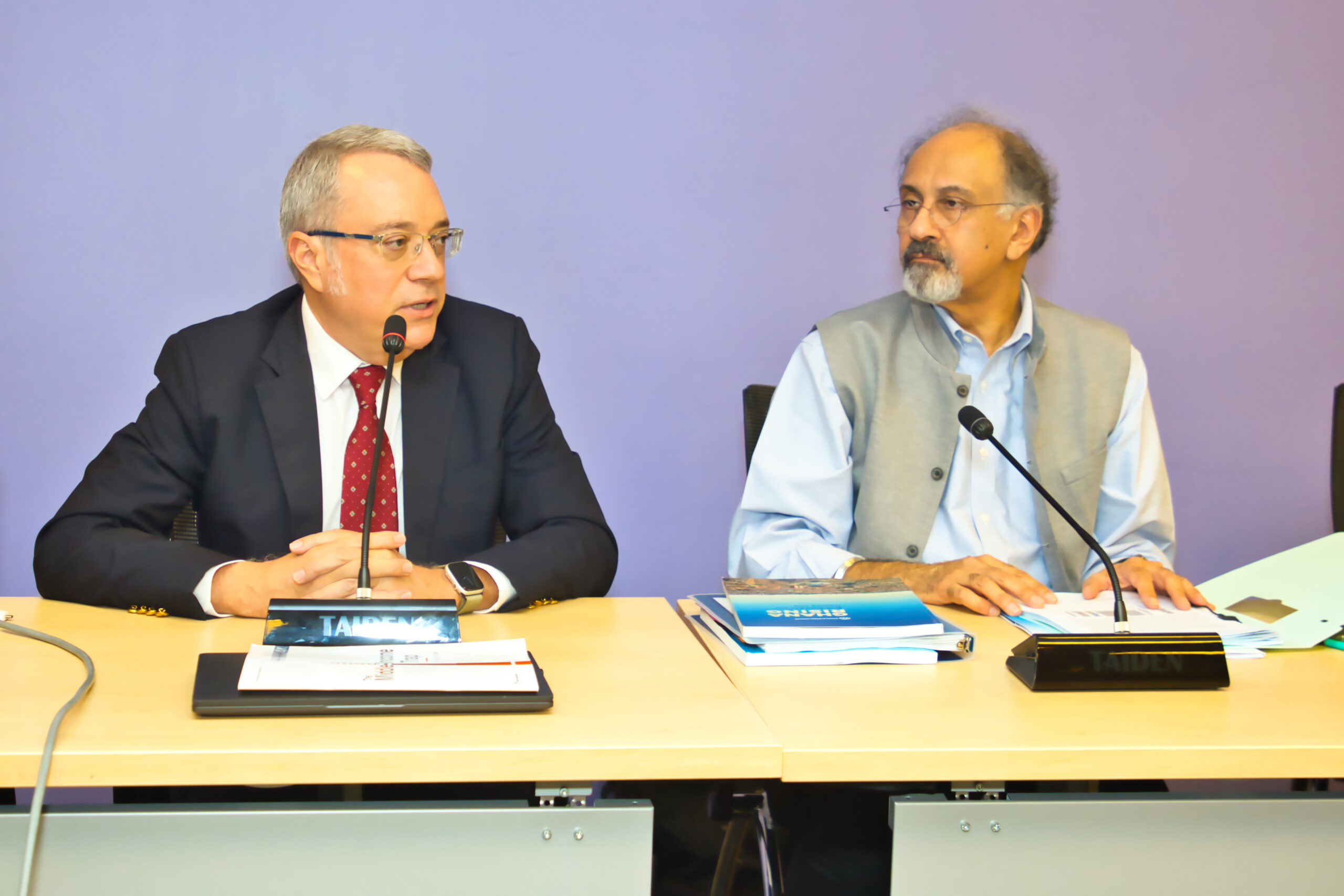

Indermit Gill
Accra, Ghana//-Distinguished panellists at the launch of the World Bank’s latest report, “Middle-Income Trap”, have called on the Government of Ghana to urgently recreate the investment climate to attract more and retain investments in the country.
According to the panellists comprising the First Deputy Government of Bank of Ghana, Dr Maxwell Opoku-Afari; Professor Peter Quartey of ISSER; Swiss Ambassador to Ghana, Simone Giger; UN Resident Coordinator in Ghana, Charles Abani; and the President and CEO of ACET, Ms Mavis Owusu-Gyamfi, the government’s continued dependent on borrowing to develop the country is not the best.
Speaking on a panel discussion after the report in Accra, Ambassador Giger said the country could make sure that it recreates its investment climate to attract more investments and make the existing investors happy so that they would leave for other countries with similar business environments.
She urged Ghana to go back and recall what it got right in the first place that resulted in the reduction of poverty as well as what it did to move into the middle-income lower bracket in 2010. If that analysis is done, it is likely to get the country beyond the middle-income trap, Ambassador Giger added.
On his part, Dr Opoku-Afari also called for the immediate need for strategic investments to drive structural transformation in Ghana’s economy as the country seeks to move beyond its current middle-income lower status.
“The key issue for Ghana is about investment. We need to do more to ensure that these investments change the structure of the economy”.
Dr Opoku-Afari noted that economic growth should be built on solid, sustainable foundations rather than short-term fiscal adjustments. This remark is aligned with a broader recognition of the country’s vulnerability to external shocks, as illustrated during the recent economic turmoil triggered by global commodity price fluctuations and a reliance on external financing.
Ms Owusu-Gyamfi said one of the things that struck in the report was the openness of the Ghanaian market and how that openness of market enables infusion, skills, and technology.
She asked: “So, what went wrong in Africa? There was a lot of openness of markets in countries like Ghana, and we did not see that infusion of technology and skills for the transition that the report talked about. So, where did it go wrong?
The Director of the Institute of Statistical Social and Economic Research (ISSER), Prof Peter Quartey, said the country should pay serious attention to innovation to help drive the growth and development of the country.
The UN Resident Coordinator in Ghana, Charles Abani, said it is time for Ghana and other developing countries in the middle to break out of the trap and urged the countries to put their limited resources into good use.
In a keynote address and presentation of the World Development Report 2024: “The Middle-Income Trap”, Chief Economist of the World Bank Group and Senior Vice President for Development Economics, Indermit Gill, said: “The battle for global economic prosperity will largely be won or lost in middle-income countries”.
“But too many of these countries rely on outmoded strategies to become advanced economies. They depend just on investment for too long—or they switch prematurely to innovation. A fresh approach is needed: first focus on investment, then add an emphasis on the infusion of new technologies from abroad, and, finally, adopt a three-pronged strategy that balances investment, infusion, and innovation. With growing demographic, ecological and geopolitical pressures, there is no room for error.”

Indermit Gill
The report proposes a “3i strategy” for countries to reach high-income status. Depending on their stage of development, all countries need to adopt a sequenced and progressively more sophisticated mix of policies. Low-income countries can focus solely on policies designed to increase investment—the 1i phase.
But once they attain lower-middle-income status, they need to shift gears and expand the policy mix to the 2i phase: investment and infusion, which consists of adopting technologies from abroad and spreading them across the economy.
At the upper-middle-income level, countries should shift gears again to the final 3i phase: investment, infusion, and innovation. In the innovation phase, countries no longer merely borrow ideas from the global frontiers of technology—they push the frontier.
“The road ahead won’t be easy, but countries can make progress even in today’s challenging conditions,” said Somik V. Lall, Director of the 2024 World Development Report. “Success will depend on how well societies balance the forces of creation, preservation, and destruction. Countries that try to spare their citizenry the pains associated with reforms and openness will miss out on the gains that come from sustained growth.”
The new World Bank report that provides the first comprehensive roadmap to enable developing countries to escape the “middle-income trap found out that more than 100 countries—including China, India, Brazil, and South Africa—face serious obstacles that could hinder their efforts to become high-income countries in the next few decades,
Drawing on lessons of the past 50 years, the World Development Report 2024: The Middle Income Trap finds that as countries grow wealthier, they usually hit a “trap” at about 10% of annual U.S.
GDP per person—the equivalent of $8,000 today. That’s in the middle of the range of what the World Bank classifies as “middle-income” countries. Since 1990, only 34 middle-income economies have managed to shift to high-income status—and more than a third of them were either beneficiaries of integration into the European Union or of previously undiscovered oil.
At the end of 2023, 108 countries were classified as middle-income, each with annual GDP per capita in the range of $1,136 to $13,845. These countries are home to six billion people—75% of the global population—and two out of every three people living in extreme poverty.
They generate more than 40% of global GDP and more than 60% of carbon emissions. And they face far bigger challenges than their predecessors in escaping the middle-income trap: rapidly ageing populations, rising protectionism in advanced economies, and the need to speed up the energy transition.
South Korea is a standout example in all three phases of the 3i strategy, the report says. In 1960, its per capita income stood at just $1,200. By the end of 2023, that number had climbed to $33,000.
South Korea began with a simple policy mix to increase public investment and encourage private investment. That morphed in the 1970s into an industrial policy that encouraged domestic firms to adopt foreign technology and more sophisticated production methods.
Korean companies responded. Samsung, once a noodle-maker, began manufacturing TV sets for domestic and regional markets. To do so, it licensed technologies from Japanese companies—Sanyo and NEC. Samsung’s success fueled demand for engineers, managers, and other skilled professionals. The South Korean government responded in turn.
The Ministry of Education set targets—and increased budgets—for public universities to help develop the new skill sets demanded by domestic firms. Today, Samsung is a global innovator in its own right—one of the world’s two largest smartphone manufacturers.
Other countries followed similar paths—including Poland and Chile. Poland focused on raising productivity with technologies infused from Western Europe. Chile encouraged technology transfer from abroad—and used it to drive domestic innovation. One of its biggest successes involved adapting Norwegian salmon farming technologies to local conditions, making Chile a top exporter of salmon.
