

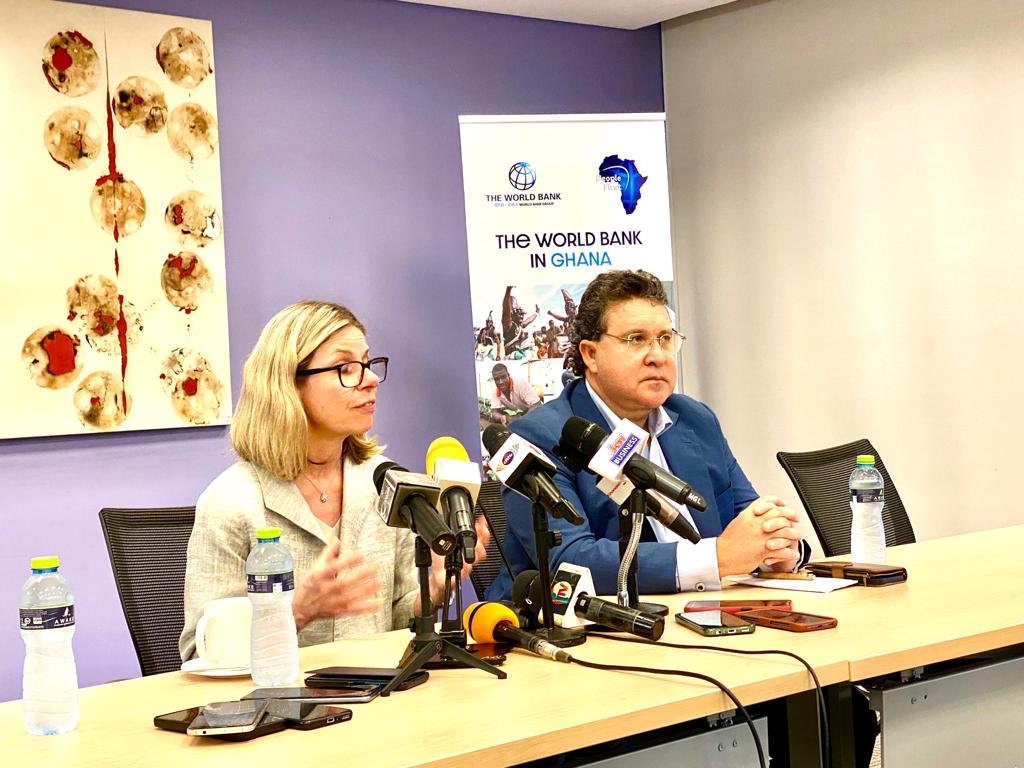

Accra, Ghana//-The World Bank’s Managing Director (MD) of Operations, Ms Anna M. Bjerde says for Ghana to avoid power crisis it must immediately put in place an emergency energy action plan.
According to her, any further delay in the implementation of the much-needed action plan in the face of the current power generation and distribution challenges could derail the country’s economic recovery.
Ms Bjerde made the call at a media briefing in Accra on Friday evening to end her maiden four-day working visit to Ghana since her appointment in April 2023.
She assured the Ghanaian government that the Bank was ready to help the country with the needed technical and related support to fix the energy sector challenges.
Ms Bjerde who perfectly diagnosed the country’s energy sector challenges noted that most of Ghana’s cost in the energy sector is on the generation side, and therefore called for a swift flow of money from the collection points to finance the generation of electricity.
“Ghana has both financial and network losses, and if not addressed with an emergency action plan, that could cost the State more to keep the energy sector running at a time when they need to spend more on other things”.
Ms Bjerde also called on the managers of the country’s energy sector to pay special attention to addressing the challenges in the metering, billing, and collection systems to recoup the needed revenue.
She warned if these challenges persist: “The generators would not be able to keep producing electricity and you would end up with interruption in supply, economic growth would be impacted, not to mention the impact of the welfare on the Ghanaian population, whether it is in school, or health centres or homes”.
The World Bank, according to Ms Bjerde “is providing technical advice on what needs to be done; the metering, billing, and collection, and making sure that you have an account set up from which all the revenue flows go”.
As part of the ongoing Ghana-IMF $3billion bailout programme, the country’s Public Utilities and Regulatory Commission (PURC) is mandated by the IMF to adjust water and electricity tariffs quarterly.
However, the Bank advised the government to balance electricity tariff adjustments, with protection of the poor and other vulnerable groups.
Ms Bjerde added that by adopting best global practices-including regulation and Public Private Partnerships (PPPs), the country could generate revenue for the energy sector.
She also used the occasion to call for an increased collaboration among the Ministries of Finance, Energy, and Gender, Children and Social Protection to have a broad package for the emergency energy action plan.
In her words: “We have a lot of experiences from around the world that we can bring to bear, but most important right now, is to implement over the next few months, these measures”.
The World Bank Country Director for Ghana, Pierre Frank Laporte encouraged the Ghanaian government to leverage the Bank’s West African Power Pool (WAPP) to address the generational challenges in the energy sector.
The WAPP allows countries of the Economic Community of West African States (ECOWAS) to pool their power systems for better use and sharing of available cheaper, greener energy resources in the economic bloc.
He urged the government to put in place robust plans and invest in renewable energy which Ghana has huge potential to produce cheap and clean energy for itself and the ECOWAS market.
Between 2013 and 2015, Ghana suffered one of its worst power crises, prompting the government of that time to invest heavily in expanding power generation.
However, huge investment was made in partnership with independent power producers (IPPs) to solve the power crisis. This development also led to the creation of more IPPs which the government must always finance to keep their power plants on to provide power 24/7 for the citizens and industries.
The government according to Ghana’s Finance Ministry currently owes the IPPs about $1.7 billion, with their constant threats of shutting down their power plans.
Just recently the government had an undisclosed payment agreement with the IPPs, after they had threatened to plunge the country into darkness.
