

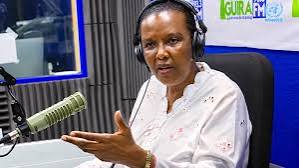
Central African Republic// — Just days before the end of her tenure, the Special Representative of the Secretary-General for the Central African Republic and Head of MINUSCA, Valentine Rugwabiza, used her final press conference in Bangui to take stock of the progress made since taking office in April 2022.
“The Central African Republic I will be leaving at the end of November 2026 is not the same Central African Republic I found in April 2022,” she said, adding that the country now stands on “a solid foundation for peace”, even though several gains remain fragile and will require sustained commitment.
She recalled that Resolution 2836, adopted unanimously by all 15 members of the Security Council on 12 November, extends the mandate of MINUSCA until 15 November 2027.
This unanimous vote reflects the United Nations’ commitment to standing alongside the Central African people. The new mandate opens a phase of consolidation in which the protection of civilians remains at the heart of the Mission’s work, as MINUSCA continues working with the Government to plan a gradual, orderly and realistic transfer of certain responsibilities to national institutions. “The transition is being prepared in practice. It is not merely a matter of discussing it,” she stressed.
Among the major achievements, the Head of MINUSCA highlighted the self-dissolution of 11 of the 14 armed groups that had signed the Political Agreement for Peace and Reconciliation, as well as the advanced disarmament of the UPC and 3R armed groups.
“As of 20 October, more than 1,900 of their combatants had been disarmed since July 2025,” she said, before calling for efforts to accelerate their socio-economic reintegration to prevent any return to violence.
She also welcomed the holding of the 2025 and 2026 elections in all 85 sub-prefectures – compared with very limited coverage in 2020 – including the country’s first municipal elections since 1988, a historic milestone for decentralisation.
She stressed that newly elected officials must be provided with the resources needed to carry out their responsibilities and also emphasised that the increased representation of women in municipal councils should translate into real influence over decision-making processes.
Border areas, however, remain vulnerable to regional instability. “The attack on Am Dafock would not have occurred without the war in Sudan,” Valentine Rugwabiza recalled, calling for a stronger and more effective presence of the State in these areas.
When asked about the Mission’s reconfiguration, she gave assurances that it means “neither the departure nor the disengagement of the Mission”. Instead, resources are being concentrated in the most fragile areas, with a more mobile force and long-range patrols. With 10,290 troops physically deployed against an authorised ceiling of 12,000, MINUSCA retains sufficient flexibility to respond to any sudden deterioration – provided it has sufficient air assets, particularly helicopters.
Turning to the challenges the Mission has faced, Ms Rugwabiza pointed to subregional crises, incursions by armed groups, the rising cost of living and the liquidity crisis affecting peace operations.
In the face of the budget cuts imposed in 2025 and 2026, she insisted that “it was out of the question to sacrifice the priority tasks of the mandate”. MINUSCA therefore maintained its support for the elections, the protection of civilians, the extension of State authority and humanitarian actors, while postponing several major construction projects to preserve these priorities.
Addressing young people, Ms Rugwabiza urged them to place peace above political divides, recalling that “peace cannot be a partisan issue”. “Peace cannot be outsourced. Peace cannot be imposed.
Peace must be built by Central Africans themselves,” she also emphasised. Reaffirming MINUSCA’s commitment to press freedom, she paid tribute to the essential role of the media in consolidating peace, telling journalists that they are “no less peacebuilders than those who contribute to protection through physical means”.
Speaking about relations with the Government, Ms Rugwabiza highlighted an approach grounded in listening and aligning the mandate with national priorities, in a manner that is “always supportive and never a substitute”.
Reflecting on the often-harsh criticism she faced upon assuming office, she said it had never weakened her determination to implement the mandate entrusted to her. In her view, the example of Bria, where residents, the authorities and MINUSCA are working together to rehabilitate the Bria–Yalinga road, is a tangible illustration of the spirit of “working together” which is one of the foundations of peacebuilding.
Describing the record on the Political Agreement as “positive”, Ms Rugwabiza stressed that its implementation remains incomplete, recalling that “as long as one or more armed groups have not been dissolved, that means there is still work to be done”. She underscored the need to consolidate the gains achieved and to continue working with the Government toward a coordinated and orderly transition process in order to “break, once and for all, the cycle of recurring conflicts”.
Valentine Rugwabiza will leave the Central African Republic on 30 November 2026, at the end of her term as head of MINUSCA. She will be succeeded by Mohamed Ag Ayoya, who will assume his duties as the Special Representative of the Secretary-General and Head of the Mission on 1 December 2026.
