
Key points
- The world is on track to exceed the Paris Agreement’s 1.5°C goal, with the global average temperature in 2025 about 1.4°C above the pre-industrial average.
- Climate change is already creating major economic risks. Estimates cited in the report project losses equivalent to 10% of global GDP at 3°C of warming.
- Global exports linked to solar and wind energy value chains exceeded $1.8 trillion in 2025, highlighting the growing importance of climate-related industries.
- Climate-related provisions are becoming more common in trade agreements, appearing in more than half of agreements signed between 2016 and 2021.
- Implementation remains limited. Only 7% of climate-related provisions identified in recent trade agreements address reducing tariff and non-tariff barriers.

The report examines how trade can support climate action at a time when climate impacts are becoming more severe and costly. It argues that access to technologies, investment, services and knowledge will be critical for countries seeking to adapt to climate change and reduce emissions.
Trade can also help countries diversify their economies and build resilience. However, the report stresses that stronger implementation and greater trade cooperation are needed to turn commitments into concrete results.
Climate risks are rising as economic costs grow
Between 2015 and 2025, the world experienced the 11th warmest years on record. In 2025, the global average temperature was about 1.4°C above pre-industrial levels. The world is on course to exceed the Paris Agreement’s 1.5°C goal. These trends bring growing economic risks.
At 3°C of warming, one estimate cited in the report projects losses equivalent to 10% of global GDP. In poorer countries closer to the equator, losses could reach 17% of GDP. Another estimate projects global GDP losses of around 40% by 2100 under a high-emissions scenario.
The report calls for faster implementation of climate commitments, including trade cooperation to improve access to climate technologies.
Climate technologies are central to adaptation and mitigation
The report identifies affordable access to climate technologies as essential for adapting to climate change and reducing emissions.
More than half of the 41 technology needs assessments reviewed identified technologies for collecting and storing water and making agriculture more resilient to climate change as priorities for adaptation. For reducing emissions, solar, hydropower, bioenergy and low-carbon transport technologies were among the most frequently identified.
Because many of these technologies are produced through international value chains, trade policies can affect their cost, availability and deployment.
Global exports of goods associated with solar and wind energy value chains exceeded $1.8 trillion in 2025, growing faster than exports of other manufactured goods. Reducing unnecessary trade barriers could help make climate technologies more affordable and accessible, especially in vulnerable developing economies.
Climate provisions are spreading across trade agreements
Climate-related provisions have become more common in trade agreements. More than half of the agreements signed between 2016 and 2021 included climate-related provisions, compared with 18% of agreements concluded between 1990 and 2015, before the Paris Agreement was adopted.
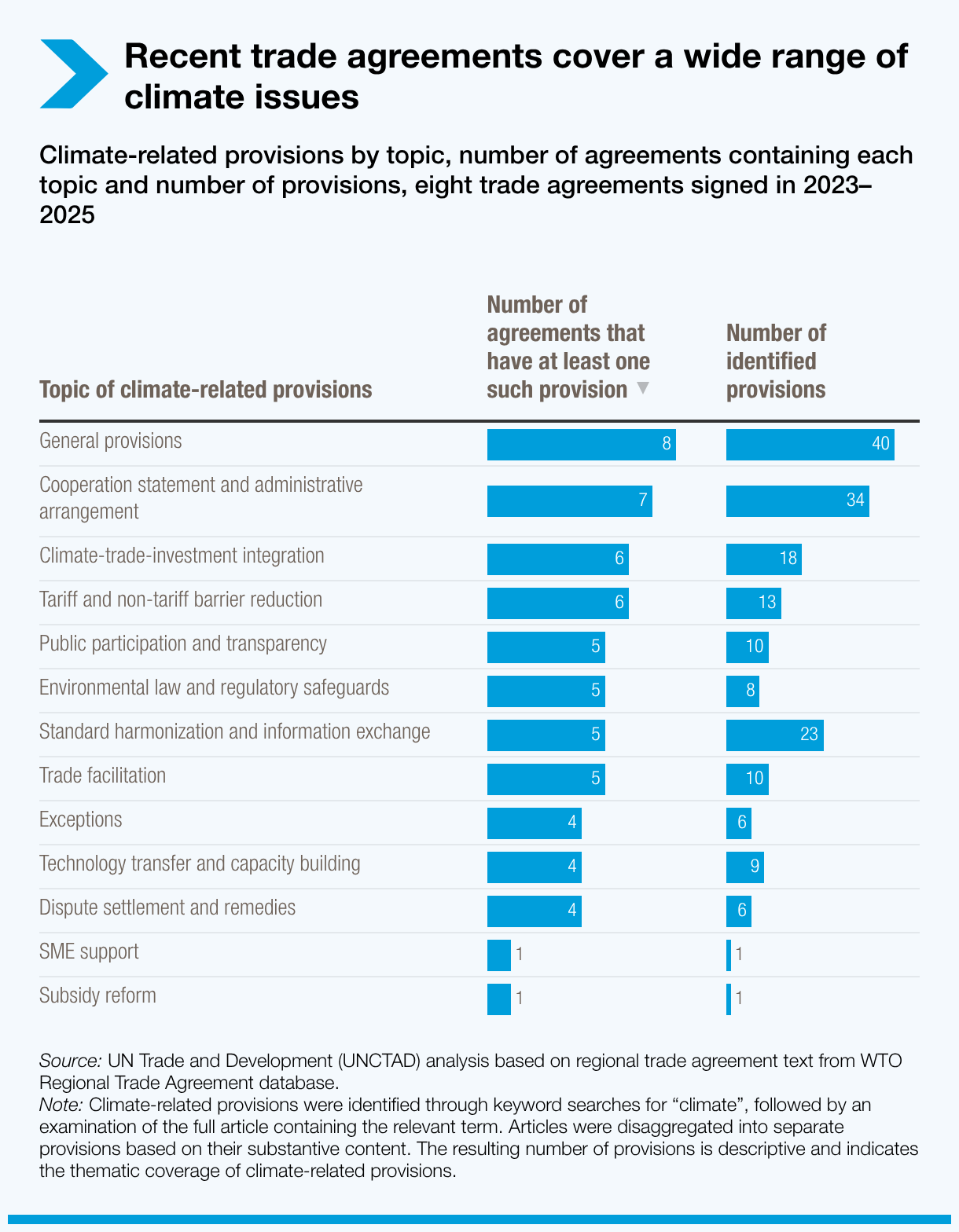
The report identified 179 climate-related provisions in eight trade agreements signed between 2023 and 2025 that reference the Paris Agreement.
However, the scope of these provisions varies. About 22% express general climate intent and 18% focus on cooperation. Only 7% address reducing tariff and non-tariff barriers.
The report says that closing the gap between commitments and delivery will require trade cooperation that supports tangible climate action, including better access to climate technologies, greater coordination on standards and support for climate-related industries.
Sustainable sectors offer opportunities for diversification
The report highlights growing trade opportunities linked to low-carbon sustainable industries.
Developing economies are already exporting substantial amounts of goods and services in sustainable sectors:
- $1.3 trillion in biodiversity-based goods in 2024.
- $1.2 trillion in ocean goods and services in 2025.
- An estimated $204 billion in non-plastic substitutes in 2024 (estimate)
According to the report, these sectors can help broaden production and export bases and strengthen resilience to external and climate-related shocks.
The report notes that success will depend on generating more value locally, creating jobs and ensuring environmental sustainability and inclusion.
From commitments to action
The report concludes that trade can play a larger role in supporting climate adaptation, emissions reduction and economic resilience.
Achieving that goal will require stronger implementation of existing commitments and better access to climate technologies. It will also require deeper trade integration and cooperation and greater support for developing economies to build the skills and productive capacity needed to participate in climate-related value chains.