
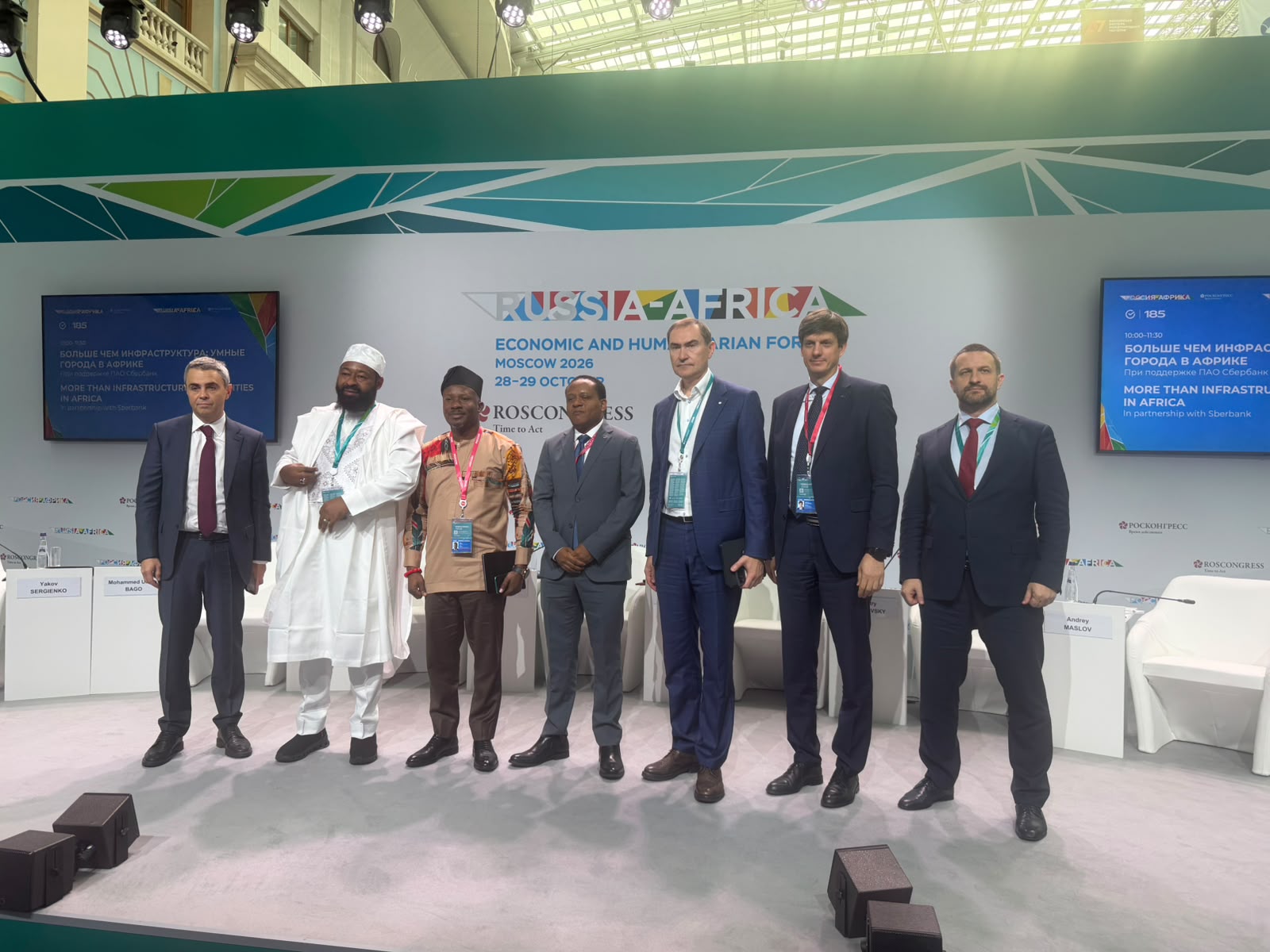
Moscow, Russia//-African nations can leverage Russian technologies, ranging from construction and IT solutions to digital mapping, medical services, education, and settlements in national currencies, said First Deputy Chairman of the Sberbank Executive Board Alexander Vedyakhin at “More Than Infrastructure: Smart Cities in Africa,” a session of the Russia–Africa Economic and Humanitarian Forum.
The session addressed the necessity of using national currencies for settlements to foster cooperation between Russia and Africa. The speaker noted that conducting transactions in rubles is a key avenue for strengthening business ties.
Alexander Vedyakhin, first deputy chairman of the Executive Board, Sberbank:
“We have many points of mutually beneficial cooperation with African countries. Having determined the lines of mutual work, we are already building financial relationships. First of all, these are, of course, national currencies and the ruble.
We see an improvement and strengthening of this interaction and are confident that further projects will only grow. Business development is only possible through partnership between the financial sectors of countries, which is why Sber is making great efforts to organize payment cooperation between Russia and African countries.”
The speaker also named digital cartography as a progressive area of cooperation.
Alexander Vedyakhin, first deputy chairman of the Executive Board, Sberbank:
“If a state wishes to develop its own mapping services, Sber and its partners are prepared to give them the platform they need. Using this geographic foundation, a country or region — for instance, Niger — could build its own tailored solutions. For residents, this primarily means greater convenience in daily life: the ability to quickly locate a specific organisation, plan a route, or choose a mode of transport.
For government authorities, it offers an accurate picture of the urban environment, revealing, for example, a shortage of schools, clinics, or public transit stops, or showing how urban development is expanding and how traffic patterns are shifting.
However, no solution can simply be transplanted ‘as is’; every project requires adaptation to local conditions, involving African colleagues, local experts, and, most importantly, the residents themselves, as they are the ones who best understand what their city should be like.”
At the end of the session, Alexander Vedyakhin emphasised once again that Russia possesses advanced technological solutions that are highly relevant to African nations. He noted that Sber is ready to share its expertise, helping to foster the growth of skills and knowledge directly within African countries.
This transfer of expertise is primarily facilitated by inviting partners to Russia to see functioning technologies — ranging from healthcare and IT training to artificial intelligence and smart-city security — followed by the development of a customised roadmap for each country.
The discussion also featured John Aggrey, CEO of the Ghana Russia Centre for Commerce and Relations; Dmitry Dyrmovsky, CEO of STC Group; Leo Peter Magomba, director of the ICT Infrastructure Unit of the Ministry of Communication and Information Technology of the United Republic of Tanzania; Andrey Maslov, director of the Centre for African Studies, National Research University Higher School of Economics; and Mohammed Umaru Bago, governor of Niger State of the Federal Republic of Nigeria. The discussion was moderated by Yakov Sergienko, general director of Yakov & Partners.
