


Ghana recorded about 450 suspected yellow fever cases between June and September 2026, according to Health Minister Kwabena Mintah Akandoh. Of these, 74 were reported in the Upper West Region, with three laboratory-confirmed cases.
The figures raise two questions: how much of the suspected caseload is actually yellow fever, and how well does Ghana know who is protected against the disease?
The second question matters because vaccination coverage is not the same as verified immunity. A child may be counted as vaccinated in administrative records, an adult may hold a vaccination certificate, and yet the underlying records may not always tell the same story.
450 suspected cases are not 450 infections
Yellow fever is a potentially deadly viral disease spread through the bite of infected mosquitoes. Symptoms include fever, headache and muscle pain, while severe cases can cause jaundice, organ failure and death. Vaccination is the most effective protection against the disease.
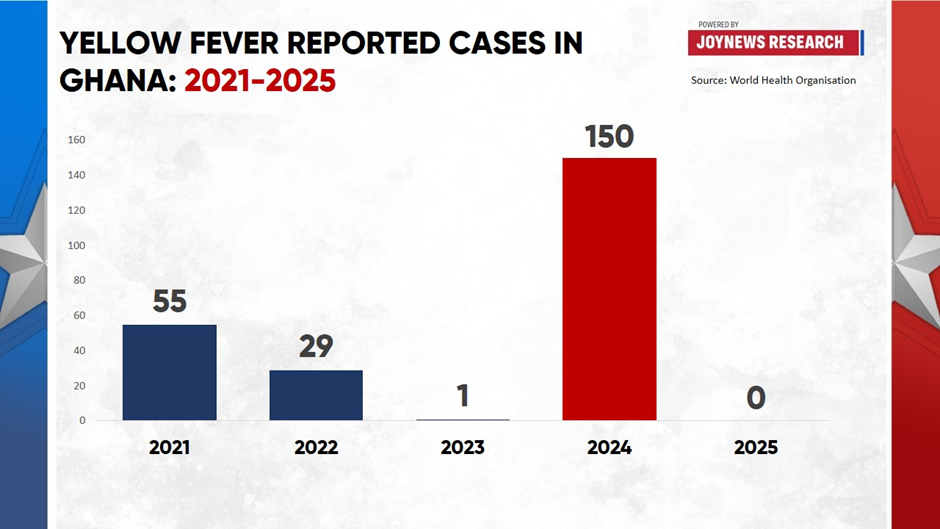
Data from the World Health Organisation (WHO) recorded 235 reported yellow fever cases in Ghana between 2021 and 2025, using the series in the original analysis. But comparing that figure directly with the 450 suspected cases reported in 2026 would be misleading: the two numbers do not measure the same thing.
Suspected cases are people who meet criteria for investigation. Confirmed cases have undergone the required testing and classification. Some suspected cases may be confirmed; others will be discarded after investigation.
The 2021 outbreak illustrates the distinction. WHO reported 202 suspected cases, of which 70 were confirmed. That is a confirmation rate of about 35%. Ghana Health Service subsequently reported a larger number of suspected cases and confirmed infections as investigations continued.
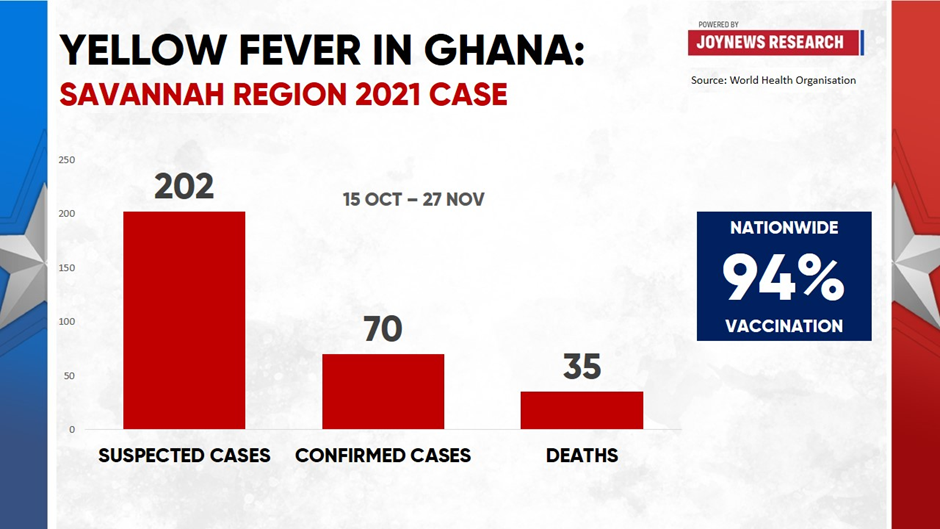
Applying the 2021 confirmation rate to today’s 450 cases would not tell us how many infections Ghana has now. The populations, timing, testing capacity and epidemiological circumstances may differ.
The Ministry has reported 450 suspected cases but has not provided a national breakdown of confirmed, negative and pending results. Without this, the scale of transmission and progress of the response remain unclear.
Upper West accounts for roughly one in six suspected cases
The Upper West Region accounts for 74 of the 450 suspected cases — approximately 16.4%, assuming the regional figure is included in the national total.
Three of those 74 have been confirmed. That means about 4.1% of the region’s suspected cases had been confirmed at the time of the Minister’s announcement. This is a provisional confirmation proportion, not an estimate of the region’s eventual infection rate.
The regional concentration deserves attention because Upper West has experienced yellow fever outbreaks before.
A study of the 2021 Wa East outbreak identified 57 suspected cases, of which 12 were laboratory-confirmed. Four of the confirmed patients died. The research also found routine yellow fever vaccination coverage in the district was only 25% before the outbreak, rising to 95% after a mass vaccination campaign.
The implication is not that the current cases have the same cause. It is that national vaccination averages can conceal communities where protection is considerably weaker.
What national vaccination coverage actually tells us
WHO/UNICEF estimates put Ghana’s routine yellow fever vaccination coverage at 94% in 2021, 95% in 2022 and 88% in 2023. WHO’s latest regional report puts coverage at 91% in 2025.
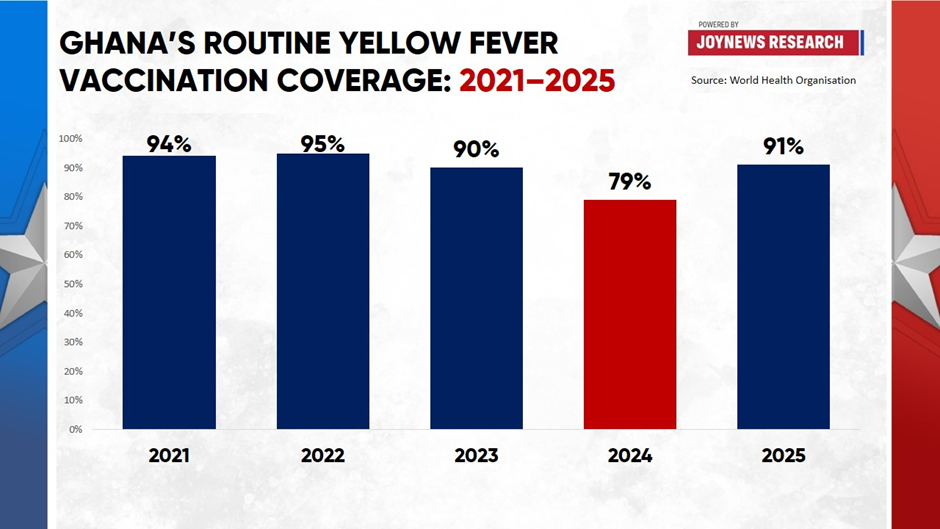
These figures are estimates of the share of the target population receiving routine vaccination. They are not a direct count of every vaccinated person, and do not establish the vaccination status of the people currently under investigation.
Even at 91% coverage, the national average leaves room for missed children and local pockets of low protection. It also says little about adults who were not vaccinated as children, people who have moved between communities, or people whose vaccination records cannot be verified.
The economic and public-health problem is one of coverage, distribution and measurement. A high national average can coexist with local gaps, and an administrative record can appear complete without providing a reliable picture of who has actually received the dose.
The vaccination card: proof of protection or proof on paper?
This is where the process of getting vaccinated becomes central.
A yellow fever vaccination card — the International Certificate of Vaccination or Prophylaxis (ICVP) — is a formal record of vaccination. It is not the vaccine itself. The certificate should follow the administration of the dose by an authorised provider.
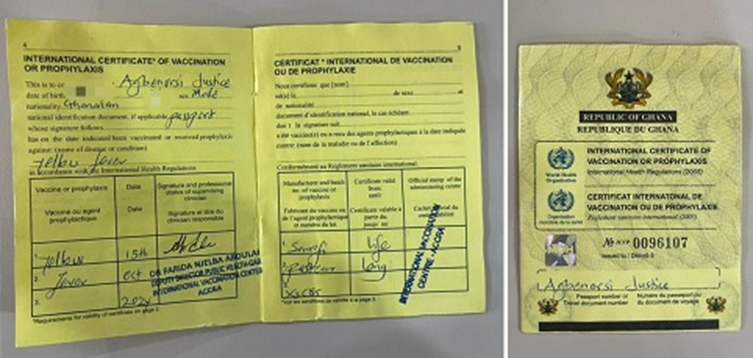
There are two distinct risks for Ghana.
First, a person may hold a certificate without having received the vaccine. If a card is issued without the dose being administered, the record falsely suggests protection. That person may travel believing they are protected, while health authorities may count them as vaccinated. The result is a gap between documented coverage and actual vaccination.
Second, a person may have received the vaccine but lack a usable certificate. The person may be protected, but a lost, incomplete or inconsistent record can make that protection difficult to establish at a border or during an outbreak investigation.
Yellow fever vaccination is generally considered to provide lifelong protection after one dose. A false certificate can leave someone vulnerable, while a missing certificate can create unnecessary administrative barriers for someone who has been vaccinated.
However, the existence of these risks does not establish how often cards are issued without vaccination in Ghana. That requires evidence from vaccination centres, travellers, health authorities and certificate records.
How could a card be issued without a dose?
The process should make the certificate dependent on a verifiable vaccination event.
A traveller attends a designated vaccination centre, screened by an authorised health professional, receives the vaccine where eligible, and have the administration recorded. The certificate is then be with the correct personal details, vaccination date, authorised signature and official stamp.
A potential weakness arises if these steps are separated — for example, if a certificate can be completed without a corresponding vaccination entry, if records are maintained only on paper without reconciliation, or if the certificate is treated as a product to be purchased rather than a record of a clinical procedure.
Those are possible control weaknesses to investigate, not established findings about Ghana’s current system.
To determine whether they occur, health authorities should reconcile a sample of issued certificates against vaccination registers, dose stocks and administration records. They should also examine complaints about unofficial payments, missing records, duplicate certificates and cards issued outside authorised centres.
The danger extends beyond the individual
A certificate issued without vaccination can create three layers of risk. For the individual: the traveller may believe they are protected when they are not.
For surveillance: an inaccurate record may lead health workers to classify someone as vaccinated when assessing a suspected case or investigating a cluster.
For public-health planning: if vaccination records are inflated, administrative coverage could overstate the population’s actual protection. That could make gaps harder to identify and targeted campaigns harder to plan.
The scale of that risk in Ghana cannot be quantified without data on certificate issuance and verification. But the mechanism is clear: a vaccination system is only as reliable as the link between the dose administered and the record created.
The reverse problem also matters. If vaccinated people lose their cards and there is no accessible record to verify their status, health workers may struggle to distinguish them from people who have never received the vaccine.
The current outbreak investigation provides an opportunity to examine the entire chain of protection. The immediate priority is to establish how many cases are confirmed and where transmission is occurring. But the investigation should also test a wider assumption: that high reported vaccination coverage necessarily means high, verifiable protection in every community
If Ghana cannot reliably connect certificates to vaccination records, it risks overstating coverage and overlooking people who remain vulnerable.
