

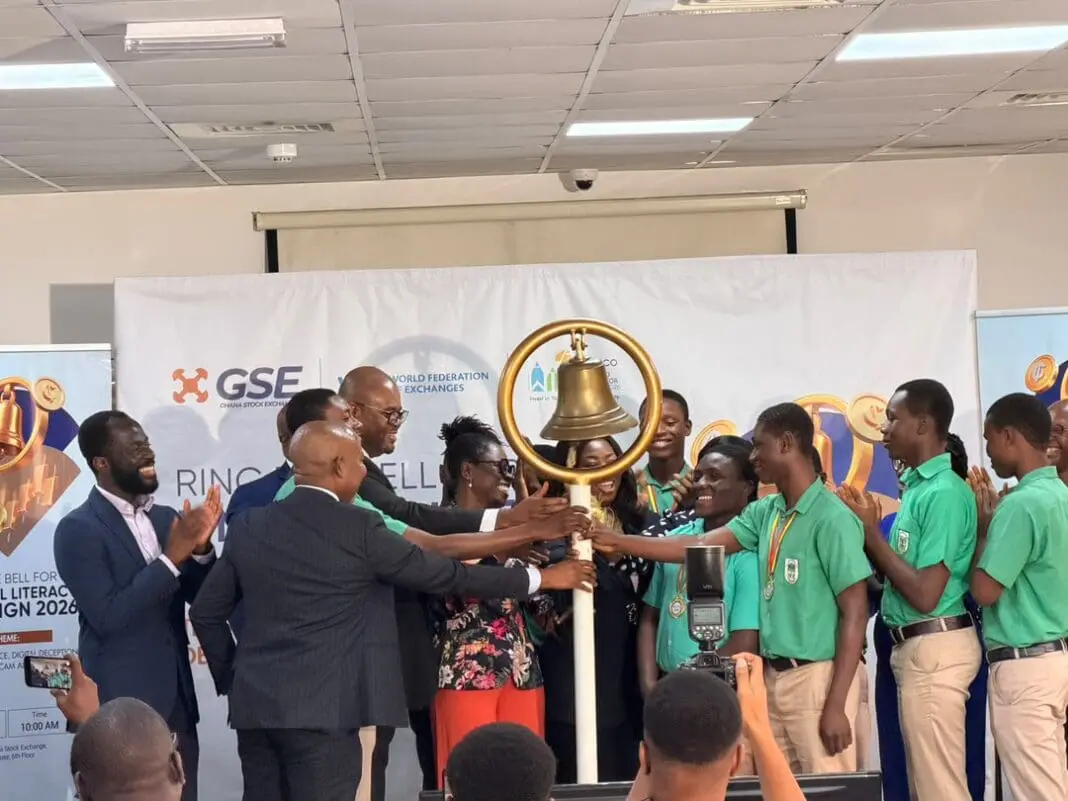
Accra, Ghana//-The Ghana Stock Exchange (GSE), in partnership with the World Federation of Exchanges (WFE) and the International Organisation of Securities Commissions (IOSCO), has deepened financial literacy through the annual Ring the Bell for Financial Literacy campaign in the country.
The Managing Director of the Ghana Stock Exchange, Madam Abena Amoah, disclosed this at ‘Ring the Bell for Financial Literacy Campaign 2026’ to mark the month’s World Investor Week.
According to her, since 2022, the GSE has worked alongside the Young Investors Network, the Central Securities Depository, the Ghana Securities Industry Association, the Ministry of Finance and other partners to take financial literacy programmes directly to senior high schools and tertiary institutions nationwide.
Those efforts have reached more than 381,000 students across over 409 schools, Madam Amoah added.
Furthermore, the GSE and its partners are actively making reliable tools available to investors, pointing to the Central Securities Depository’s recently launched InvestorConnect app and platforms introduced by stockbrokers, such as IC Securities, as direct channels for market access and verified information that reduce reliance on hearsay.
Madam Amoah indicated that the GSE treats investor education as an essential part of how the market functions.
The annual event which was on the theme- ‘Investor Resilience, Digital Deception and Scam Alert’ brought together senior officials of the GSE, Ministry of Finance, the Securities and Exchange Commission (SEC), the Bank of Ghana, the Ghana Securities Industry Association, the Cyber Security Authority (CSA), and other key partners.
They discussed emerging forms of investment fraud, common warning signs, practical ways to protect investors, among others.
In her welcome address, Madam Amoah was emphatic that the annual campaign forms part of a global effort to strengthen financial literacy and promote informed investment decisions in the West African country.
She observed that technology continues to make capital markets far more accessible that enables investors to open accounts and place orders through their phones from virtually anywhere in the world.
Madam Amoah however, cautioned that the very same channels bringing investors closer to the market are being actively exploited by fraudsters for their selfish interests.
Scammers or fraudsters now operate across social media, messaging applications and mobile money platforms, with some presenting themselves as financial influencers, she added.
Their methods, according to her, include cloning legitimate firms’ websites, impersonating corporate email addresses, using the names of established professionals and creating artificial urgency to pressure people into acting before conducting adequate checks.
In her own words: “The damage goes beyond the person who loses money,” warning: “Every scam makes the next honest investor a little more hesitant.”
Trust is the market’s most valuable asset, stressing that it takes much longer to build than to lose, Madam Amoah said.
Her personal scam experience
She recounted a personal scam experience to show how sophisticated these threats have become.
She revealed that she received an email at about 5 a.m. on October 1 purporting to come from the chief executive of a company licensed by the Securities and Exchange Commission.
The message offered a short-term trading opportunity with a guaranteed return of between 50 and 70 per cent within just 12 hours.
The message invited her to reply or contact the company through what it described as an official communication channel to receive documentation and further information before deciding whether to participate.
Madam Amoah said that the email contained no typographical errors and displayed the name of a company she dealt with regularly.
This, according to the GSE MD, made it appear convincing on the surface. However, her cybersecurity training prompted her to examine the sender’s address more closely.
Although the company’s name appeared as the display sender, the actual email address ended in “gmail.com.”
Knowing the company did not use a Gmail address for official correspondence, the discrepancy alerted her to the suspicious offer.
Despite having almost 30 years of capital market experience, she initially found the message convincing, Madam Amoah said.
She admitted that without the specific training she had received on identifying warning signs, she could have fallen victim.
This led her to question how vulnerable ordinary members of the public without similar experience and training might be when confronted with such messages.
Madam Amoah acknowledged that the experience reinforced the vital importance of protecting investors’ hard-earned income and savings, as well as ensuring that investment opportunities are offered strictly within a properly regulated market. She warned that a breakdown in trust would undermine the market and its ability to attract investment.
Vigilance
Touching on the theme, Madam Amoah defined investor resilience as “the ability to recognise suspicious promises, such as guaranteed returns of 50 to 70 per cent within 12 hours, and being prepared to walk away”.
She noted that resilience does not mean avoiding every financial risk, but understanding the difference between legitimate investment risk and outright fraud.
Digital deception involves fake endorsements, impersonation, cloned platforms and unsolicited messages offering supposedly exclusive opportunities.
Scam awareness requires a practical habit of pausing, verifying and then deciding before acting, she said.
She therefore encouraged students and young investors, in particular, to pay close attention to presentations on digital innovation and financial scams.
While young people’s frequent use of digital platforms makes them prime targets, it also positions them to lead the way in educating others about safe investment practices.
Verify Investment Stories
She used the event to express strong concern over unverified reports published as capital market exclusives that later prove false, calling on journalists to obtain information from credible, official sources and verify claims directly with transacting parties prior to publication.
Madam Amoah reminded the media of their responsibility, emphasising that financial reporting directly impacts public savings, livelihoods, and futures, making accuracy far more critical than speed.
“Scams spread quickly. Protection needs to spread even faster,” she stated, while expressing gratitude to the WFE, IOSCO, the International Finance Corporation, the SEC, the Ghana Securities Industry Association, and other partners for their support.
She was confident that the bell-ringing event would catalyse heightened financial literacy and a more resilient domestic capital market.
Commitment
Head of the Capital Market Unit at the Ministry of Finance, Ms Elizabeth Owiredu, renewed the government’s commitment to strengthening investor protection across the length and breadth of the country.
She explained that protecting investments has become increasingly important as more Ghanaians saved, invested and transacted through digital channels in the country.

Ms Owiredu went on to describe investor education and protection as central to the government’s economic agenda and broader capital market development efforts.
Ghana’s capital market has made significant progress following the Domestic Debt Exchange Programme, with improvements in fixed income and equity market activity and growing public interest in investing, according to her.
Domestic investors now hold about 70 per cent of government securities, compared with approximately 30 per cent held by foreign investors, Ms Owiredu disclosed.
Impact of investment fraud
She warned that a single fraudulent scheme could wipe out a family’s life savings, disrupt market activity and undo years of painstaking work to build public trust.
Noting that while digital platforms have expanded access to financial services, they have also created opportunities for fraudsters to reach potential victims.
Collaboration
To effectively tackle fraud, Ms Owiredu called for a close collaboration among key regulatory and security bodies, including the National Insurance Commission, the National Pensions Regulatory Authority, the Cyber Security Authority, the Financial Intelligence Centre, the Economic and Organised Crime Office and the Ghana Police Service, to detect, disrupt and prosecute fraudulent schemes promptly.
She said the government supported financial literacy campaigns undertaken by regulators and market bodies, including the Ghana Securities Industry Association and the Young Investors Network.
Investment opportunities
Growing interest in digital assets reflected innovation and demand for new investment opportunities, but equally raised concerns about public exposure to unregulated platforms.
Ms Owiredu pointed out that a clear government policy response is essential to protect investors while supporting market development.
She reiterated the Ministry’s commitment to working with the Securities and Exchange Commission, the GSE and other stakeholders to strengthen investor education and protection, while supporting increased market participation, improved liquidity, more listings and innovative financial products.
Mrs. Owiredu also lauded the GSE’s National Investment Quiz, stating that it was helping young people develop the knowledge, integrity and innovative thinking needed to shape Ghana’s financial future.
The initiative, according to her, is equipping young people to make informed decisions and avoid fraudulent schemes.
SEC Warns
Daniel Bebaako Mensah, speaking on behalf of the Director General of the Securities and Exchange Commission, Dr. James Klutse Avedzi, said a strong capital market depended not only on investment and innovation, but also on trust, knowledge and investor protection.
He said the growth in digital financial transactions had expanded access to financial services while creating more opportunities for fraudsters to reach the public, making financial literacy an essential form of protection.
He said the SEC continued to encounter Ponzi and pyramid schemes promising unusually high or guaranteed returns, unlicensed investment and fund management operations, digital investment scams and affinity fraud.
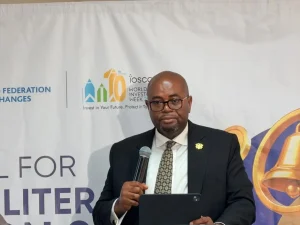
He explained that affinity fraud exploited trust within churches, families, associations and other communities.
Mr Bebaako Mensah warned that investment fraud was increasingly taking digital forms, with perpetrators using TikTok, WhatsApp and Telegram to promote schemes promising guaranteed daily returns.
He said fake trading platforms, fraudulent applications and artificial intelligence-generated reviews and endorsements were also being used to make fraudulent schemes appear credible. These tools, he noted, enabled a single fraudster to reach thousands of potential victims at very little cost.
Mr Bebaako Mensah urged investors to verify investment opportunities before committing their money, cautioning against relying solely on certificates, logos, social media pages or assurances from promoters.
He said fraudsters could forge certificates and copy official logos, making it necessary to confirm a firm’s licensing status through the SEC’s official channels.
He advised investors to be cautious about guaranteed or above-market returns, pressure to invest immediately and offers that appeared too good to be true. Emphasizing that investors should also insist on proper documentation and conduct independent checks.
Stiffer sanctions
Mr Bebaako Mensah explained that the Securities Industry Act, 2016 (Act 929), as amended, mandated the SEC to regulate and promote an efficient, fair and transparent securities market that protects investors and market integrity.
He said the Virtual Asset Service Providers Act, 2025 (Act 1154), also assigned the Commission responsibilities as a co-regulator of virtual asset services in Ghana.
As investment activity increasingly moved into digital and virtual asset spaces, he said the SEC’s response included licensing and supervising market operators, issuing public warnings about unlicensed entities, overseeing virtual asset activities and providing investor education through programmes such as “Time with the SEC.”
He said the Commission also collaborated with the Bank of Ghana, the Economic and Organised Crime Office, the Financial Intelligence Centre and the Cybercrime Unit of the Ghana Police Service.
Mr Bebaako Mensah disclosed that work was underway to strengthen the legal framework for dealing with prohibited investment schemes and their promoters.
Under the proposed reforms, he said, the SEC would have stronger powers to seal the premises of operators of prohibited schemes, freeze their assets and seek forfeiture through the courts.
The proposals would also hold promoters and financial influencers jointly liable for promoting such schemes. According to him, the proposed sanctions included fines of up to 250,000 penalty units, imprisonment of up to 15 years or both.
He said the measures reflected the seriousness of investment fraud and its potential to destroy livelihoods, families and confidence in the financial system.
Report Suspicious Scheme
Mr Bebaako Mensah encouraged the public to report suspicious investment schemes and unlicensed operators through the SEC’s official channels, including its toll-free line, 0800 100 065, and website, www.sec.gov.gh.
He said reports should also be made to the appropriate law enforcement agencies and, where money laundering was suspected, to the Financial Intelligence Centre.
Mr Bebaako Mensah described the bell ringing ceremony as a call for vigilance, responsible investing and collective action against financial fraud. He urged investors to question promises of easy or guaranteed returns and never allow urgency to replace due diligence.
He reaffirmed the SEC’s commitment to investor education, effective regulation and the development of a vibrant capital market.
CSA Calls for Stronger Coordination
The Head of Cybersecurity Technology and Standards at the Cyber Security Authority (CSA), Jake France, also highlighted the growing threat of technology-driven investment fraud and called for stronger institutional coordination to combat cybercrime.
Mr France cited mobile money fraud, fintech-related schemes, impersonation, online blackmail, and ransomware among the primary threats managed by the Authority.
He cautioned that modern investment scams increasingly rely on artificial intelligence-enabled deception, fraudulent social media campaigns, and fake trading platforms.
