

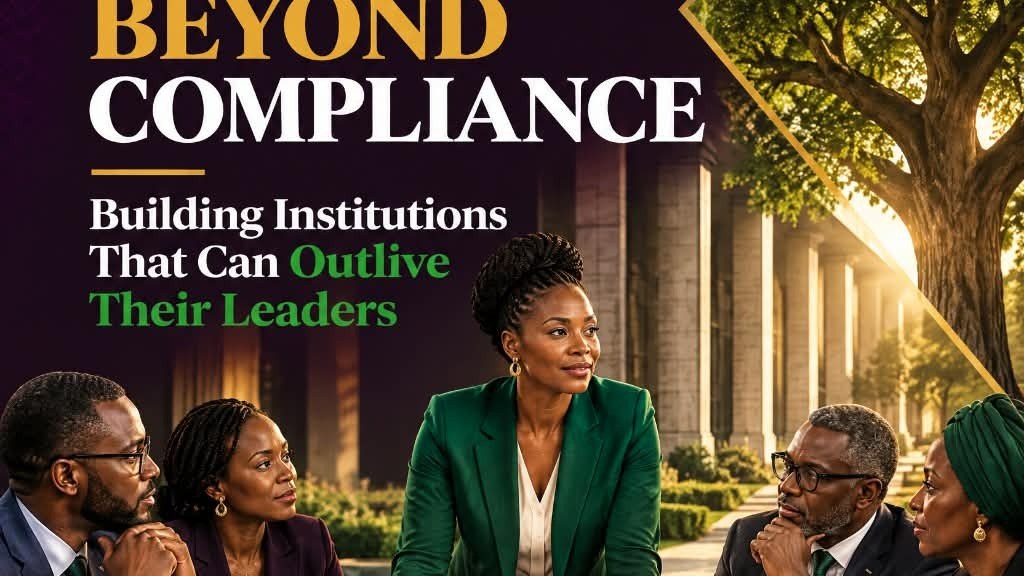

As businesses grow, governance must grow with them. Sustainable institutions are built when strong leadership becomes strong systems, accountable decision-making, and institutional memory.
Governance must grow with the business
One lesson I have learnt from working in banking, consulting, leadership development, and entrepreneurship is that having good people matters, but good people alone do not build a strong institution.
A company can have a competent CEO, an experienced board and hardworking employees and still become vulnerable when a few key people leave. Sometimes the reason is simple: too much of the organisation sits in people’s heads.
One person knows the important clients. Another understands how a critical process works. A senior executive holds the relationships that make things happen. Certain approvals move quickly because somebody knows whom to call. For a while, this can look like efficiency. It becomes a problem when the person leaves.
A strong institution must therefore be deliberately built to work beyond the individuals who currently lead it. This thinking shaped the SHIELD Institutional Governance Framework™, which I developed around six practical disciplines of institutional leadership.
The SHIELD Institutional Governance Framework™

Strong systems: reduce key-person dependency
Consider a senior employee leaving and suddenly nobody knows the status of several client relationships. Agreements are sitting in someone’s email. A supplier arrangement was made verbally. A process everybody assumed was established turns out to have been managed by one person.
That is not primarily a people problem. It is a systems problem. Strong systems mean that important organisational processes do not depend entirely on particular individuals. Good governance often begins with getting these basics right.
Honest and ethical leadership: what leaders model matters
Policies matter, but employees pay close attention to what leaders actually do. If a company says procurement must follow a process but senior executives routinely bypass it, employees quickly understand which standard is real.
Ethical leadership therefore has to be visible in everyday decisions. I see leadership as stewardship. A CEO, director or manager may control significant resources, but those resources do not personally belong to the leader. They have been entrusted to the leader for a period.
Independent oversight: good leaders need challenge
Strong executives should not fear strong governance. Boards need to do more than receive presentations and approve recommendations. They need to ask why an investment is being made, what assumptions support it, what could go wrong and what alternatives management considered.
The same applies to finance, audit, risk and compliance. These functions should be able to raise concerns without being treated as obstacles to business. Sometimes the person slowing down a decision is actually protecting the institution.
Evidence-based decisions: test assumptions before the market does
Experience and intuition matter, but neither should replace evidence. If a business wants to open another branch, enthusiasm about the location is not enough. What is the expected market? What will it cost? What revenue can realistically be generated? What does customer data show? How long will it take to break even?
Good leadership combines experience with evidence. The same discipline should apply to recruitment, partnerships, new products, borrowing and major investments.
Leadership accountability: connect authority to outcomes
One of the practical questions organisations should ask more often is: Who owns this? A strategic plan may contain many initiatives, but unless each one has an owner, a timeline and an expected outcome, it can become a document discussed at meetings without changing the business.
Accountability is not primarily about blame. It is about clarity: what was agreed, who is responsible, when it should be completed, how success will be measured and what happens when delivery consistently falls short. Accountability should become stronger as authority increases.
Documentation and disclosure: protect institutional memory
Documentation may not be the most exciting subject in leadership, but it is one of the most important. I have seen situations where everybody remembers a meeting differently. One person says an amount was approved; another says it was only discussed. A short written record could have prevented months of confusion.
Minutes, contracts, approvals, procedures, client records, intellectual property and important decisions should not disappear when employees leave. Appropriate disclosure also ensures that boards, investors, regulators and other legitimate stakeholders receive the information they need to make sound decisions.
Six questions every board should ask
1. Which critical processes currently depend too heavily on particular individuals?
2. Are the standards expected from employees visibly demonstrated by leadership?
3. Can the board and control functions genuinely challenge powerful executives?
4. Can we show the evidence behind our most significant strategic and financial decisions?
5. Does every major priority have a clear owner and measurable outcome?
6. If today’s leadership team left, could the next team reconstruct the key decisions, commitments and lessons that brought the institution here?
The business case for governance
For corporate institutions and growing SMEs, governance should not be treated as a compliance exercise detached from commercial performance. Strong governance supports continuity, protects capital, improves decision quality, strengthens confidence and makes succession less disruptive.
The real test often comes when people leave. If customers disappear because one executive left, there was a relationship but perhaps not yet an institutional relationship. If a process collapses because one employee resigned, there was expertise but not yet an institutional system. If strategy changes completely whenever a new leader arrives, the organisation may have leadership but not enough institutional direction.
Succession should therefore be about more than identifying the next CEO. It should also consider what systems, knowledge, culture and decision-making disciplines the next generation of leaders will inherit.
From leadership success to institutional legacy
The institutions that endure are rarely those that depend on one extraordinary person. They are organisations in which good leadership has gradually been converted into good systems.
For me, the ultimate test of institutional leadership is simple: after we have left, does the organisation still know what to do, why it is doing it, who is responsible and what standards must not be compromised?
If the answer is yes, then we have done more than lead. We have built an institution.
About the Author

By Dr Genevieve Pearl Duncan
Dr Genevieve Pearl Duncan is a Business Strategist, Executive Coach, Institutional Leadership and Sustainability Practitioner. With more than two decades of professional experience, including extensive experience in banking, her work focuses on executive leadership, institutional development, governance, sustainability and building organizations capable of enduring impact.
She is the developer of The SHIELD Institutional Governance Framework™ (2026).
Framework Attribution
The SHIELD Institutional Governance Framework™ and its six-pillar formulation – Strong Systems, Honest & Ethical Leadership, Independent Oversight, Evidence-Based Decisions, Leadership Accountability, and Documentation & Disclosure – were developed by Dr. Genevieve Pearl Duncan in 2026. Broader governance principles are informed by established organisational governance and internal-control literature.
Suggested citation: Duncan, G. P. (2026). The SHIELD Institutional Governance Framework™: Building institutions that are accountable, ethical, resilient and sustainable.
