



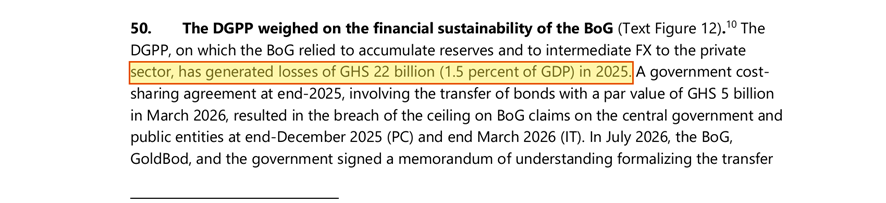
For the first time since 2021, the Bank of Ghana is no longer buying gold. In July 2026, the central bank, GoldBod, and the government signed a memorandum of understanding formally transferring Ghana’s Domestic Gold Purchase Programme (DGPP) and every quasi-fiscal risk that comes with it entirely to the Ghana Gold Board.
It is being sold, fairly, as a clean-up: a programme that generated an estimated GH₵22 billion in losses in 2025 alone is finally off the central bank’s books. But a closer reading of the IMF’s own account of the handover, the Sixth Review Staff Report and its companion Selected Issues Paper, both published in the past six weeks, tells a more complicated story.
The BoG hasn’t shut the programme down. It has handed it to GoldBod, expanded it, and attached a demanding list of conditions. What was once the central bank’s problem is now entirely GoldBod’s.
Until early 2026, GoldBod’s role in the gold trade was narrow: it acted as a buying agent for the Bank of Ghana, sourcing artisanal gold through a network of aggregators and earning a fee for doing so. The Bank of Ghana financed the purchases, took on the trading and pricing risk, and absorbed whatever losses resulted.
That arrangement is now gone. According to the IMF, GoldBod stopped receiving BoG funding for its gold purchases from March 2026. From August 2026, it began raising its own money for artisanal gold purchases directly from commercial banks and off-takers, the exporters who buy the gold from GoldBod once it has been aggregated.
The Bank of Ghana’s role has shrunk to that of a fiscal agent: it still handles the foreign exchange mechanics and still receives gold destined for the country’s official reserves, but it no longer owns the risk.
That last detail matters. The IMF classifies the transfer as a “prior action”, Fund language for a condition that had to be completed before the IMF would even complete its review of Ghana’s programme. In other words, this was not a voluntary restructuring GoldBod and the BoG arrived at on their own timeline. It was a condition the IMF required.
Quick Recap: What this programme actually cost
The DGPP’s losses were small at first and grew explosively as it scaled. Here’s the year-by-year picture, drawn from the IMF’s own figures:
The IMF’s own explanation of where the money went in 2025, quoted directly from its Selected Issues Paper, is worth reading in full because the same three cost items it lists are exactly what GoldBod must now bring under control on its own:
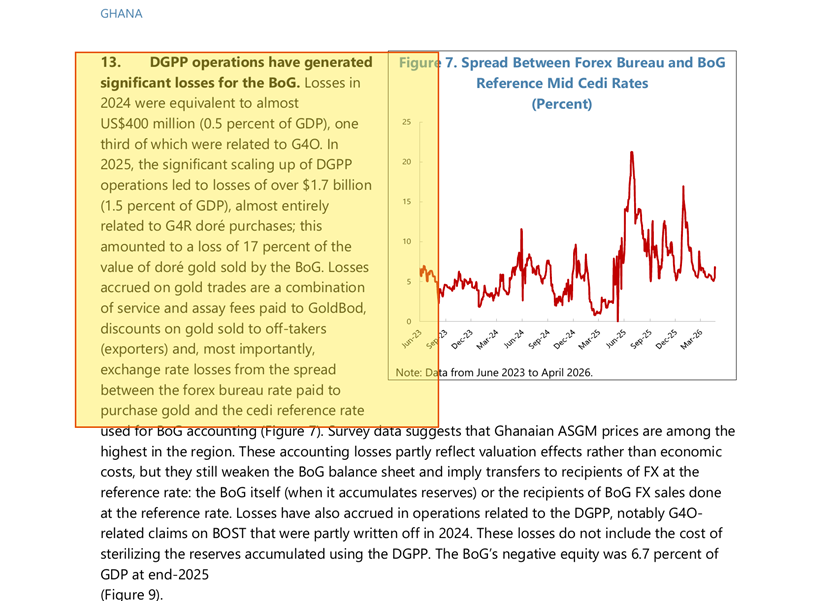
Of the three components, GoldBod’s own fees, discounts paid to off-takers, and the exchange-rate spread between the price gold was bought at and the rate used for accounting, the IMF says the exchange-rate spread was “most importantly” the biggest single driver, roughly half the total loss on its own. GoldBod’s fees were the smallest slice.
What Actually Changes for GoldBod’s Operations
This is the part that matters most going forward. Four things are different for GoldBod now that it didn’t have to deal with it as a mere buying agent.
1. It now owns the trading risk, not just the fee.
Previously, GoldBod earned a fee regardless of whether the BoG made or lost money on the gold it bought. That protection is gone. GoldBod’s expanded trade model, which began in April 2026, means it now buys, holds, and sells gold on its own account, so if the same forex-spread and off-taker-discount losses that hit the BoG recur, they now land directly on GoldBod’s own books, not the central bank’s.
2. It must finance itself.
Gold purchases used to be funded with Bank of Ghana money. Since August 2026, GoldBod has been sourcing that financing itself from commercial banks and the same off-takers it sells gold to. That is a fundamentally different, and more expensive, funding model than borrowing, in effect, from the central bank.
3. Its costs are under a hard target it hasn’t hit yet.
The memorandum of understanding that formalised the handover sets a cost ceiling of 5 per cent of the value of gold purchased, covering fees, discounts and the forex spread combined. Real progress was made, cutting costs from roughly 14–15 per cent in 2025 to around 11–12 per cent in early 2026. But it is still more than double the target it is contractually required to reach.
4. It now has to publish audited numbers the public can actually check.
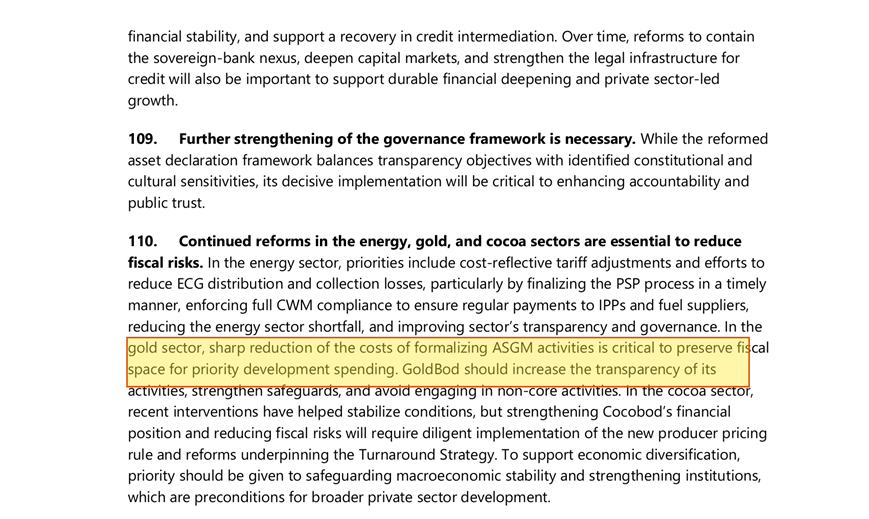
Under the IMF-backed reform programme, GoldBod must publish externally audited annual financial statements by end-June 2027, with detailed reporting on gold volumes, operational costs, and any transfers it receives from government. This is a formal, dated commitment, not a vague promise of “transparency”.
Already Happening: Buyers say they’re not being paid
Recent Reuters reports indicate that GoldBod has gone as long as three weeks without paying some of its licensed gold suppliers, forcing some buyers to halt purchases or borrow to stay afloat—this despite gold prices currently surging on international markets.
“The last two weeks were terrible. You could spend a whole day waiting and not receive any funds,” a gold trader in the Ashanti Region told Reuters. A buyer in the Western Region said he had gone unpaid for about three weeks. Five industry sources spoke to the news agency, all on condition of anonymity.
GoldBod disputes that there is any shortfall. The agency said its gold-purchasing operations remained fully funded and operational and rejected any suggestion it had abandoned or was unable to finance its statutory mandate, saying funding decisions are instead based on a supplier’s creditworthiness, security, and risk profile.
But the timing lines up closely with exactly the operational shift this analysis flagged above. Kwaku Ohemeng Amoah, chief executive of the Chamber of Gold Buyers, told Reuters that GoldBod’s move to fund the trade from its own balance sheet after decoupling from the Bank of Ghana may itself have contributed to the funding constraints and suggested buyers may need to seek supplementary financing of their own.
For this analysis, the significance is straightforward. The self-financing requirement identified as GoldBod’s second major operational change, replacing Bank of Ghana funding with commercial-bank and off-taker financing, is not a smooth mechanical substitution. It is already producing exactly the kind of cash-flow strain that could push formalised gold buyers back toward informal, unregulated financing, undermining the very smuggling-reduction goal GoldBod exists to serve.
Here’s what makes this handover more than a simple clean-up: at the same time GoldBod is being asked to cut costs and absorb full risk, the government wants it to buy considerably more gold than the Bank of Ghana ever did.
Under the Ghana Accelerated National Reserve Accumulation Policy (GANRAP), the plan is to push reserves to 15 months of import cover by 2028, well beyond the roughly 6 months the IMF itself considers adequate. GoldBod is central to how that happens.
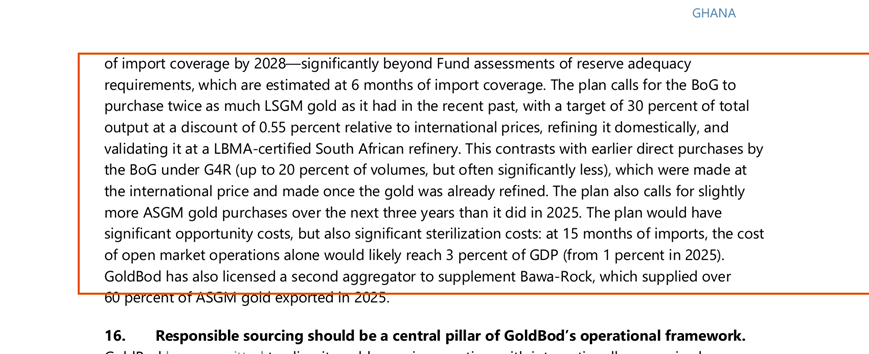
Buy twice as much large-scale mine gold as before, targeting 30 per cent of total large-scale output, up from around 20 per cent. Refine gold domestically rather than importing it already refined, then validate it at a newly designated LBMA-certified refinery in South Africa with new infrastructure and logistics GoldBod didn’t need to manage before.
Buy slightly more artisanal gold over the next three years than it did even in 2025, the year that produced the GH₵22 billion loss. Run a bigger aggregator network: GoldBod has already licensed a second aggregator alongside Bawa-Rock, which alone supplied over 60 per cent of all artisanal gold exported in 2025.
The IMF is blunt about what this will cost. At 15 months of import cover, the expense of “sterilising” the extra reserve-, the routine central-bank operations needed to mop up the cedi liquidity created whenever gold or FX is bought- would likely reach 3 per cent of GDP, up from about 1 per cent in 2025. That is a cost separate from any trading loss, and it lands on the wider economy, not just GoldBod’s balance sheet.
The Risks GoldBod Now Carries Alone
Handing the DGPP to GoldBod solved one specific problem the IMF had flagged: the mismatch where one institution earned fees while another absorbed the losses, what the Fund itself called a “moral hazard problem”. That mismatch is technically fixed now. GoldBod earns the fees and bears the losses. But that fix creates a new, more concentrated set of risks worth watching closely.
Can GoldBod actually hit the cost target?
Getting costs from today’s roughly 11–12 per cent down to the mandated 5 per cent requires structural changes that GoldBod hasn’t fully delivered yet, reducing the forex spread, streamlining a supply chain that runs through 13 mining regions, and negotiating better terms with off-takers who have historically had the upper hand in doré gold deals. If GoldBod can’t get there, it now absorbs the shortfall itself, without a central bank balance sheet to quietly cushion it.
Is its financial cushion as strong as it looks?
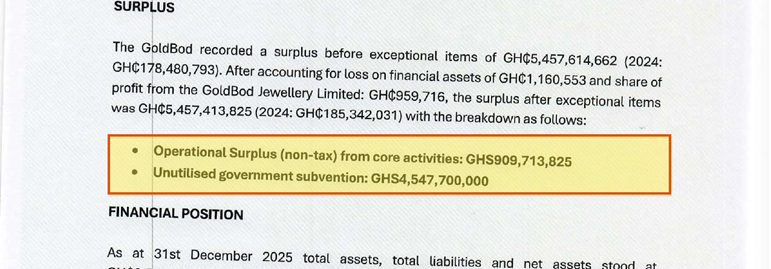
GoldBod’s audited 2025 accounts show a surplus of GH₵5.44 billion, reassuring on its face. But GH₵4.55 billion of that is an unspent government capital subvention, not trading profit. Strip that out, and GoldBod’s actual operating surplus from its fee-based business was GH₵909.7 million.
That is the more realistic number to weigh against the scale of what GoldBod is now being asked to finance: a doubled large-scale gold purchase target, a new refining operation, and a compliance overhaul, all without government money doing the heavy lifting a second time.
The Reuters reporting above suggests this gap between headline balance-sheet strength and actual day-to-day liquidity may already be showing up on the ground, in the form of buyers waiting weeks to be paid.
A bigger bet on a single, volatile commodity.
Gold now makes up more than half of Ghana’s total exports, up from a fifth in 2021. The IMF’s own debt sustainability analysis tests what happens if global gold prices fall 30 per cent: it would force a materially tighter budget, with the government’s primary balance target rising from 0.5 to 0.8 per cent of GDP just to keep debt on track. The more Ghana leans on gold to build reserves, the more exposed the whole economy becomes to a single commodity price GoldBod does not control.
Smuggling that formalisation still hasn’t beaten.
Despite GoldBod’s mandate to formalise the sector, the IMF estimates 229 tonnes of gold worth US$11.4 billion went missing from official trade data between 2019 and 2024, smuggled out through informal channels rather than sold through GoldBod. In 2023 alone, the gap between what Ghana reported exporting and what the United Arab Emirates reported importing exceeded US$4 billion. Every tonne that leaves informally is a tonne GoldBod’s reserve-building strategy can’t count.
Environmental costs the IMF says are becoming structural.
The same artisanal mining expansion that feeds GoldBod’s gold supply is, in the IMF’s own words, degrading cocoa farmland, silting rivers, and raising costs for the Ghana Water Company and, left unchecked, risks becoming “a structural risk to agricultural productivity and long-term growth. GoldBod’s commercial interest in buying more gold and its stated commitment to responsible, OECD- and LBMA-aligned sourcing are not automatically the same thing, and the IMF is watching to see which one wins out in practice.
The Bank of Ghana didn’t just exit a losing programme; it handed GoldBod a bigger version of the same one, with a tighter cost target, a smaller financial cushion than the headline numbers suggest, and none of the central bank’s balance sheet to fall back on. Barely a month into full independence, gold buyers on the ground are already reporting the strain. Whether that is early teething trouble or the first sign of a deeper funding gap is the question the coming weeks should answer.
Myjoyonline
