

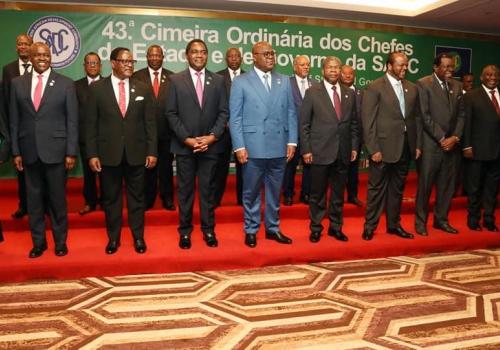
The ordinary summit of the Southern African Development Community underway has set a radical tone for the attainment of Africa’s total emancipation through, among others, achieving the African Union set Agenda 2063 and breaking free from neo-colonialism.
President Cyril Ramaphosa of South Africa, who is the current SADC Chairperson, led the charge with a spirited special lecture to the gathering held in Durban, in which he called for Africa to reclaim control of its natural resources in order to fund its own development free of Western influence.
Ramaphosa said the West never intended to do any legitimate trading in the SADC or elsewhere on the continent but just came to extract resources. “Colonialism did not merely conquer our people and occupy our land. It deliberately fragmented our region.
It divided communities, separated producers from markets and constructed transport systems designed to carry Africa’s raw materials to distant shores rather than to connect African economies to one another, said Ramaphosa.
Ramaphosa identified as example the so called Just Energy Transition as an example of a global initiative that is entirely dependent on African resources to succeed and called on for the continent to demand fair compensation for what lies below its soil by among others insisting on local beneficiation.
“This region holds a substantial share of the world’s critical mineral resources. Many of the materials upon which the energy transition of the entire planet depends lie beneath our soil.
But these minerals continue to cross our borders in raw form. We export the ore and we import the battery. We supply an industrial revolution taking place somewhere else and we then purchase its products at a price set by others.
We need to use our own resources to drive our own industrial revolution,” said Ramaphosa.
The call by Ramaphosa adds to many voices on the continent calling for an end to neo-colonialism and demanding a fair deal.
Countries such as Burkina Faso and its neighbours in the Sahel region have already put in place legislation limiting raw mineral exports to give a chance to local beneficiation, but not without resistance from France, which has retaliated with a campaign to delegitimise and ultimately topple the leaders of the three nations that are all endowed with the most sought-after resources.
Governments across the continent are increasingly rejecting aid and demanding economic justice.
South Africa is a key player in the pursuit of both the SADC’s 2050 agenda and the African Union Agenda 2063 both aimed at transforming the region and continent into middle-class societies where citizens live in comfort.
It is also part of the AU campaign championed by Ghana to demand reparations from the West for the crimes against humanity committed through colonialism and the transatlantic slave trade.
Recently, the South African government made an assertion that the demand for reparations was not negotiable, with international relations minister Ronald Lamola and Minister in the Presidency Khumbudzo Ntshavheni both coming out strongly on the matter.
“The Jews were compensated for the Holocaust, but Africans were not compensated for the slave trade and the aftereffects of colonialism,” said Ntshavheni.
“Africans deserve not only an acknowledgement of the wrongs that were visited on them, but Africans deserve to be compensated. It is for that reason that in our own country, we are redressing the injustices of the past, the injustices of the apartheid rule and colonialism,” said Ntshavheni, responding to Newsnote.
Ghana has been tasked by the African Union with championing the reparations agenda and has so far got no less than 80 countries participating, including nations in the Caribbean Islands.
It was Ghana that tabled the UN resolution, and in June held a summit on reparations in the capital, Accra.
“Ghana has always been a pan-African leader. We’re the first country to attain independence in sub-Saharan Africa and to prove that it is possible to fight imperial might and win,” BBC quotes Ghanaian Foreign Minister Samuel Okudzeto Ablakwa.
The choice of Ghana as champions for the reparations movement is significant considering that the West African country was the site where no less than 12 million people were processed and sent to the Americas.
This has earned Ghana the label of being the “crime scene” because it represents the last sight of Africa before being shipped off to the US and Europe.
By Njabulo Mkhize, CAJ News
