

A year after the August 6 helicopter crash that claimed the lives of eight people, including senior government officials, environmental advocacy group A-Rocha Ghana says Ghana is losing the fight against illegal mining, popularly known as galamsey.
The group says expectations that the tragedy would trigger a renewed and sustained national campaign against illegal mining have not been met.
Speaking on Joy News’ PM Express on Wednesday, Deputy National Director of A-Rocha Ghana, Daryl Bosu, said the country has instead lost momentum in the fight.
“You are very much on point when you say we had a lot of expectations, and I must say again that yes, we did. We did have a lot of expectations,” he said.
Mr Bosu said the helicopter crash created an opportunity for the country to build momentum and take decisive action against illegal mining.
According to him, that momentum has since been lost, and the situation on the ground has become increasingly worrying.
“This question, I’ve answered in the last, I’ll say, two weeks, and I practically had to use the word hopeless. I think that where we find ourselves, we are at a point where we are completely losing leadership.”
He said the initial response after the crash gave environmental advocates hope that Ghana would make significant progress in tackling illegal mining.
“We started well, and then when the incident happened, we all kind of like got all this sudden momentum, built this sudden momentum. Everybody was rallying behind the goal, and then somehow we lost track.”
Mr Bosu accused authorities of turning a blind eye to the problem, warning that the situation has returned to the levels that existed before the renewed national campaign.
“We took our eyes off the ball, and everything went back towards the wall, if not worse.”
He said A-Rocha Ghana had expected the country to at least maintain the gains made after the crash and reduce the environmental risks posed by illegal mining.
“I was following your statistics, your data, and I would say that I have even some more to fill in because, as you said, I mean, it’s really gotten that bad to the extent that we thought we had a baseline.”
“We’re going to maintain it then, if not even anything at all, reduce the risks, but gain some ground in terms of the campaign.”
However, Mr Bosu said recent observations from the field have left him deeply concerned about the direction of the fight.
“I mean, the way we said, and from being on the ground just last week and seeing what is happening, I had no choice but to say we are at a point of hopelessness.”
Asked whether Ghana is worse off a year after the crash, Mr Bosu responded: “Yes!”
The August 6 helicopter crash had triggered renewed calls for stronger action against illegal mining, particularly because of concerns over the destruction of forests and pollution of water bodies.
A-Rocha Ghana’s latest assessment suggests that the momentum generated by that national concern has not translated into sustained progress, with the organisation warning that the country risks losing the fight against galamsey.
Commenting on the same matter, award-winning journalist Erastus Asare Donkor has warned that Ghana is losing ground in the fight against illegal mining, with illegal miners returning to forest reserves previously cleared of destructive activities.
“Well, I have said it, and I’ll say it again: that in the area of forest reserves, we made a significant improvement,” he said.
He recalled that at the beginning of 2025, several forest reserves had been classified as “red zones” by the Forestry Commission because illegal miners had taken control of them.
“When you compare that to when we started in 2025, there were a number of red zones. The Forestry Commission describes them as red zones because there were armed people who had staged roadblocks and taken over the forest reserves, and you cannot enter,” he explained.
According to him, even forest guards and rapid response teams could not enter some of the affected areas. He cited the Tano Amiya, Yoyo and Offin Shelter Belt forest reserves as examples.
“Not even the forest guards could enter the rapid response teams, and I can mention a number of them: the Tano Amiya, Yoyo, Offin Shelter Belt, and some forest guards were killed. Some of them were maimed in those forests, and as we entered into 2026, we had zero of those red zones,” he said.
Mr Asare Donkor attributed the earlier progress mainly to the IGP’s task force and efforts by NAIMOS under Colonel Boah.
“And so it tells you that yes, we made quite significant progress in that area. And I will also add that to mainly the IGP’s task force that was set up back then, and then some efforts of NAIMOS under Colonel Boah in those particular periods,” he stated.
However, he said the situation is changing, with illegal miners gradually returning to protected areas.
“But I’m sad to say that we are retrogressing. We are going back. We are rolling back that progress,” he warned.
He said the Forestry Commission has recently indicated that illegal miners are returning to forest reserves, citing reports from Bekwai where illegal miners had allegedly pitched camps.
“Currently, as we speak, the Forestry Commission has indicated that illegal miners are coming back to the forest reserves,” he said.
“Just recently, if you saw the stories that I did from Bekwai, one of those forest reserves, we had illegal miners pitching camp in those forest reserves.”
He further raised concerns about miners using metal detectors to enter protected areas, describing them as “peeping, the dig and wash people.”
“Now we have those that we call peeping, the dig and wash people who are holding metal detectors, entering into certain areas within the Tano Awia and Tano Nimri forest reserves,” he said.
Mr Asare Donkor cautioned that unless urgent action is taken, the gains made in the fight against illegal mining could be completely lost.
“So we made the gains, but we are, you know, rolling it back gradually. And if we don’t take care, all the gains will be lost,” he said.
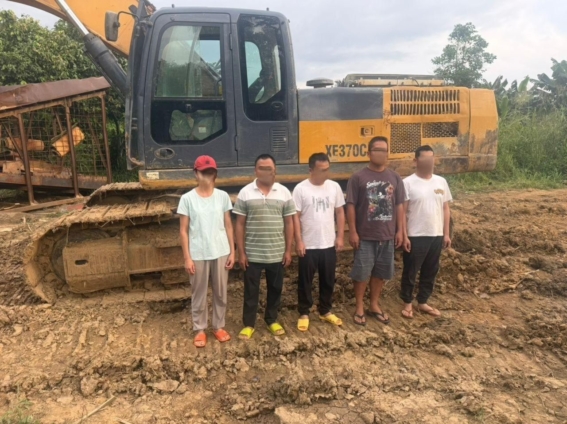
He also raised concerns over excavators seized during anti-galamsey operations but later released.
“Especially at a point where some of the excavators that were seized were released back to the illegal miners, and so that is the gain that I would say we have chalked,” he added.
Myjoyonline
