

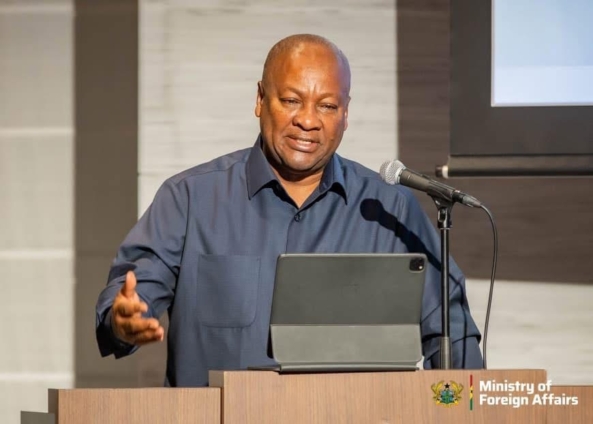
President John Dramani Mahama has commended French President Emmanuel Macron for a series of commitments aimed at addressing the legacy of the transatlantic slave trade, including the creation of a joint Ghana-French scientific commission and renewed support for reparatory justice.
In a statement, the Government of Ghana said it welcomed Macron’s announcement to work with Ghana on establishing a Ghana-French Scientific Commission on slavery in Ghana. The government also applauded Macron’s pledge to abolish slavery laws known as the _Code Noir_, his new policy on the return of looted artefacts, and his commitment to an open dialogue on reparatory justice.
“The Government of Ghana additionally applauds President Macron for accepting President Mahama’s invitation to speak at the Next Steps Summit on Reparatory Justice in Accra from June 17-19, 2026,” the statement noted.
Officials described the developments as “concrete results” of the Ghana-led UN resolution that declared the transatlantic enslavement of Africans as the gravest crime against humanity.
Background
Ghana has positioned itself at the forefront of global conversations on reparatory justice in recent years. In 2024, Ghana led the adoption of a UN General Assembly resolution recognising the transatlantic slave trade as a crime against humanity, a move aimed at framing future discussions on reparations and historical accountability.
The planned Ghana-French Scientific Commission is expected to examine the historical record of slavery in Ghana, including the role of French colonial and commercial interests. France’s _Code Noir_ refers to a set of 17th-century ordinances that regulated slavery in French colonies. Macron’s commitment to review and abolish related legal legacies signals a shift in how former colonial powers are engaging with their historical roles.
The return of looted artefacts has also gained momentum across Africa and Europe, with several European countries outlining frameworks for restitution. Macron has previously overseen the return of artefacts to Benin and Senegal.
The upcoming Next Summit on Reparatory Justice in Accra is expected to bring together African leaders, civil society groups, and international partners to outline policy pathways on reparations, restitution, and historical education.
