

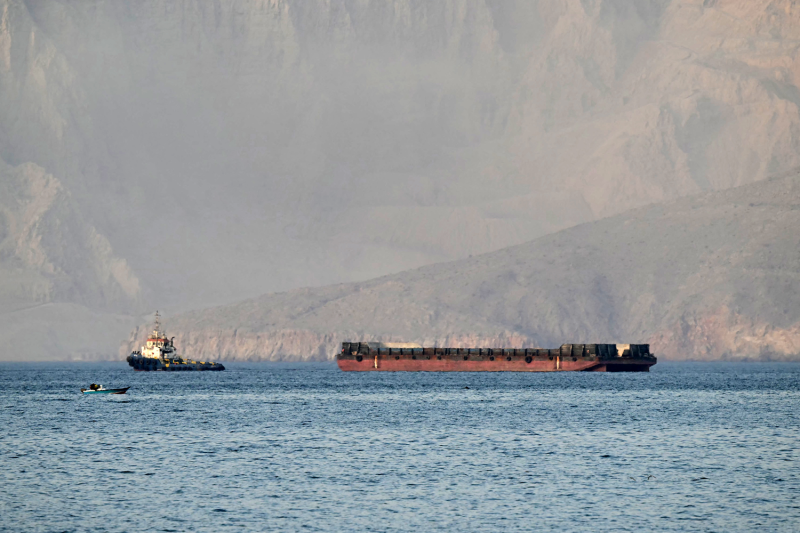

The International Energy Agency (IEA )is responding to the energy market impacts of the conflict in the Middle East.
The disruption to oil and gas flows through the Strait of Hormuz, and attacks on energy infrastructure across the region, have major implications for energy security and affordability – and for the world economy. The IEA’s Executive Director has said the combined impacts amount to “the greatest threat to global energy security in history.”
The war in the region, which began on 28 February, has impeded energy trade flows through the Strait, creating the largest supply disruption in the history of the global oil market. The global supply of liquefied natural gas (LNG) has also been reduced by around 20% due to the situation.
On 11 March, IEA Member countries unanimously agreed to carry out the Agency’s largest-ever release of emergency oil stocks to help address the market disruptions. Read the latest update on the stock release here.
Current market backdrop
Oil and natural gas prices have increased significantly since the war began. Brent crude futures surged by more than 60% in March. Dutch TTF, the European benchmark for natural gas, rose by over 60% as well.
Some markets for oil products have also been particularly affected, including those for diesel and jet fuel, whose benchmark prices more than doubled in Asia in March.
Crude and oil product flows through the Strait of Hormuz have plunged from around 20 million barrels per day (mb/d) before the war to a trickle currently. With traffic largely halted, limited capacity to bypass the crucial waterway, and storage filling up, Gulf countries have cut total oil production by more than 11 mb/d. In the absence of a rapid resumption of shipping flows, supply losses are set to increase.
Our latest monthly Oil Market Report, published 12 March, has more. Our Maritime Chokepoints Shipping Monitor also shows how flows for oil, gas and other cargoes have evolved since the start of the war, based on ships’ automatic identification system (AIS) data:
The Gulf region is a key source of refined oil products for global markets, notably middle distillates such as diesel and jet fuel. Gulf producers exported 3.3 mb/d of refined oil products and 1.5 mb/d of liquefied petroleum gas (LPG) in 2025.
More than 3 mb/d of refining capacity in the region has already shut down due to attacks and a lack of viable export outlets. Refiners outside the region are also curtailing refinery runs due to concerns over feedstock availability.
Globally, markets for middle distillates have been relatively tight compared with those for other products. As such, there appears to be little flexibility for refineries outside the region to increase output of diesel and jet fuel further to compensate in the event of sustained supply losses.
Oil-consuming countries have significant amounts of oil in storage to bridge temporary supply losses. Global observed inventories of crude and products are currently assessed at more than 8.2 billion barrels, the highest level since February 2021.
Roughly half of these are held in advanced economies, of which 1.25 billion barrels are held by governments for emergency purposes, with a further 600 million barrels of industry stocks held under government obligation. These stocks underpin the emergency collective action announced by the IEA on 11 March to make additional oil supply available to the market.
The Gulf region’s output of LNG has also been significantly impacted by the war. Global natural gas markets had been gradually rebalancing following the major shock that followed Russia’s invasion of Ukraine in February 2022.
A wave of new LNG capacity between now and the end of this decade is expected to transform market dynamics. But gas markets remained tight in the first two months of this year, with storage levels depleted coming out of the heating season in the Northern Hemisphere.
The disruption of transit via the Strait of Hormuz has reduced LNG supplies from Qatar and the United Arab Emirates by over 300 million cubic metres per day since 1 March. This translates into a loss of over 2 billion cubic metres (bcm) of gas supply every week.
The Ras Laffan facility in Qatar, which is the largest liquefaction facility in the world, has been offline since it was first attacked on 2 March. Regional gas production is also affected by the shut-in of oil fields, which has cut the output of gas associated with oil production.
Natural gas prices in Asian markets have risen sharply since the start of the war to attract more LNG cargoes, reflecting the region’s greater exposure to supply disruptions via the Strait. Higher prices and supply constraints have also prompted demand-side adjustments, including gas rationing in some countries.
Its 2026 Energy Crisis Policy Response Tracker catalogues government actions to curb demand and support consumers in response to the energy market impacts of the conflict.
IEA’s role and oil stock release
Ensuring energy security has been at the centre of the IEA’s mission since its founding in 1974, following the major oil crisis the year before. A critical aspect of this work has been to help coordinate collective responses to major oil supply disruptions by providing additional oil to the global market on a short-term basis.
Each of the IEA’s 32 Member countries has an obligation to hold oil stocks equivalent to at least 90 days of net oil imports and to be ready to collectively respond to severe supply disruptions affecting the global oil market.
On 11 March, IEA Member countries unanimously agreed to take emergency collective action to respond to the major disruptions in oil markets, making 400 million barrels of emergency oil stocks available – the largest-ever release coordinated by the Agency.
The stock release largely consists of crude oil, while in Europe, the contributions are primarily taking the form of refined oil products. This is being complemented by additional production from countries in the Americas. The latest details are available here.
The coordinated stock release is the sixth in the history of the IEA. Previous collective actions were taken in 1991, 2005, 2011, and twice in 2022.
The IEA continues to assess the energy security implications of the situation in coordination with governments around the world. A new report, Sheltering from Oil Shocks, also outlines demand-side measures that governments, companies and households can take to help ease price pressures on consumers.
IEA Director of Energy Markets and Security Keisuke Sadamori puts the release of 400 million barrels of oil from members’ emergency stocks in context and answers key questions about the decision and its implementation
Why is the Strait of Hormuz so important?
The Strait of Hormuz is a narrow sea passage, separating the Arabian Peninsula and Iran, and connecting the Persian Gulf with the Gulf of Oman and the Arabian Sea. A crucial trade artery, it is the primary export route for oil and natural gas produced by Saudi Arabia, the UAE, Kuwait, Qatar, Iraq, Bahrain and Iran.
Traffic through the Strait has been essentially halted by the conflict, putting pressure on the trade of a wide range of energy products.
Around 25% of the world’s seaborne oil trade transited the Strait in 2025, and options for oil flows to bypass the Strait of Hormuz are limited. Only Saudi Arabia and the UAE have operational crude pipelines that could potentially reroute flows to bypass the Strait, with an estimated 3.5 mb/d to 5.5 mb/d of available capacity. Other countries, including Iran, Iraq, Kuwait, Qatar and Bahrain, rely on the Strait to deliver the vast majority of their oil exports.
Alternative routes
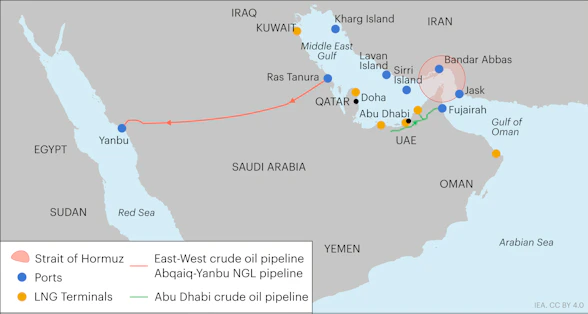
About 80% of oil and oil products transiting the Strait in 2025 was destined for Asia.
In addition, over 110 bcm of LNG passed through the Strait of Hormuz in 2025. About 93% of Qatar’s and 96% of the UAE’s LNG exports transited through the Strait, representing almost one-fifth of global LNG trade. There are no alternative routes to bring these volumes to market.
Most LNG from Qatar and the UAE goes to Asia. In 2025, almost 90% of the total volumes exported via the Strait of Hormuz was destined for the Asian market – accounting for more than a quarter of the region’s total LNG imports. Just over 10% went to Europe.
Crude oil exports transiting the strait of Hormuz by destination, 2025

Total does not match sum of adding individual numbers due to destinations not indicated. Source: IEA analysis based on Kpler.
Oil products transiting the strait of Hormuz by destination, 2025
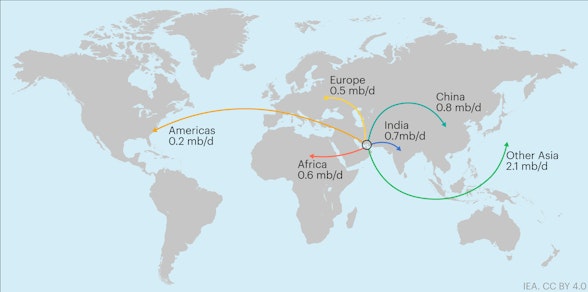
Total does not match sum of adding individual numbers due to destinations not indicated. Source: IEA analysis based on Kpler.
More information about the Strait of Hormuz
Impact on other key commodities
Various other commodities markets have also been affected by disruptions to shipping in the Strait of Hormuz, with implications for energy and beyond.
Fertiliser supply is particularly exposed. More than 30% of global trade of urea moves through the Strait, along with about 20% of trade of ammonia and phosphate. This creates risks for food prices and security. Moreover, disruptions in this sector could have indirect effects on energy markets, since some countries use imported LNG to run domestic fertiliser plants.
Additionally, the Gulf region produces around 8% of the global supply of aluminium, which is used in numerous energy technologies, as well as in construction and manufacturing. About 5 million tonnes of the metal are shipped each year through the Strait from smelters in Bahrain, Qatar, Saudi Arabia and the United Arab Emirates.
Around half of global seaborne sulphur trade also moves through the Strait of Hormuz. Sulphuric acid is used not only to produce fertiliser and chemicals, but also in the refining of petroleum and critical minerals such as copper, nickel and zinc.
