

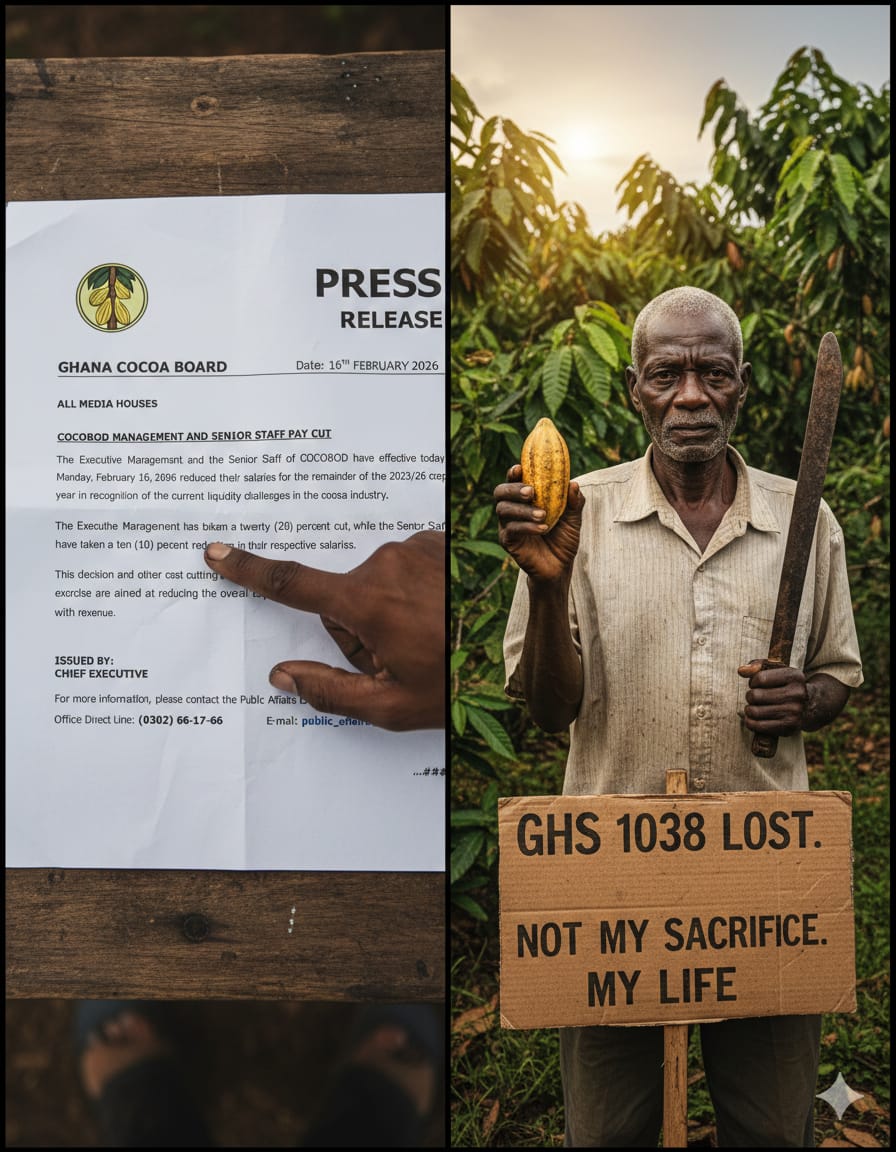
The hand that holds the machete is bleeding, while the hand that holds the pen merely signs away a surplus.
In the verdant forest belts of Sefwi, Asunafo, and Amenfi, the air is thick, not with the sweet, fermented scent of drying beans, but with the bitter musk of institutional betrayal.
For the first time in our republic’s living memory, the state has done the unthinkable: it has reached into the farmer’s weathered pocket mid-season and snatched back GHS 1,038 from every single bag of cocoa delivered.
A 28.6% slash in the producer price, dropping from GHS 3,625 to GHS 2,587 per bag, is not a mere “market alignment”; it is a declaration of economic war against the very soul of the Ghanaian countryside.
Now, in a move calibrated for the cameras and the evening news, the Executive Management of the Ghana Cocoa Board (COCOBOD) has announced a 20% pay cut for themselves. They call it solidarity. They call it “shared sacrifice.”
I call it an institutional insult wrapped in a PR shroud.
Let us speak with the bluntness that this crisis demands. When a CEO earning a mid-five-figure salary loses 20%, he sacrifices a luxury, perhaps a vintage scotch, a foreign holiday, or a premium investment. He remains insulated by the thick walls of corporate privilege.
But when a farmer loses 28% of his gross revenue, he sacrifices a life. He sacrifices the ability to buy sulphate for his trees, the fees for his daughter’s nursing school, and the basic dignity of a harvest that rewards his sweat.
The juxtaposition is jarring.
COCOBOD is currently drowning in a GHS 33 billion debt, a fiscal Titanic hitting the iceberg of global price volatility. For years, the institution operated as a “state within a state,” funding “Cocoa Roads” that often led to political convenience rather than economic efficiency.
By 2024, COCOBOD’s exposure to these road contracts reached a staggering GHS 26 billion, while administrative expenses alone surged by 37% in a single year. To offer a 20% salary reduction now, after the coffers have been emptied on non-core luxuries, is like offering a teaspoon of water to quench a forest fire.
The proposed Cocoa Board Bill is the final nail in the coffin of the post-independence social contract. For decades, the Ghanaian state was the farmer’s shield.
We socialised the risk of the London and New York markets. If the world price crashed, the state bled so the farmer could breathe. This was the “Grand Bargain” that kept our rural heartlands stable.
No more.
By introducing the Automatic Price Adjustment Mechanism, the state is effectively resigning as the farmer’s protector. We are tethering the fate of the rural poor to a digital stock ticker in Manhattan.
Under the guise of “transparency,” we are telling the man in the sun-scorched field: “You are on your own.”
The legal guarantee of 70% of the Net Free on Board (FOB) price sounds noble in a boardroom, but when the global price tumbles from $7,200 to $4,100 per tonne, that 70% becomes a guarantee of destitution, not prosperity.
Furthermore, the Bill’s mandate for 50% domestic processing by the 2026/2027 season is a lofty ambition built on hollow ground. Where are the factories? Where is the reliable, affordable power for indigenous grinders?
Despite a World Bank warning that COCOBOD’s operations pose a “significant fiscal threat,” we continue to chase headlines rather than build infrastructure.
Without the credit for local entrepreneurs to compete with global giants, we risk creating a legal bottleneck that will see our “brown gold” rot in warehouses while we wait for a processing capacity that exists only in parliamentary memos.
If COCOBOD truly wishes to show solidarity, it must do more than trim its fringes. We need a fundamental, forensic audit of the GHS 21 billion in road contracts awarded despite an annual budget of only GHS 430 million.
We need a dismantling of the opaque procurement cultures, exemplified by the $48 million order of jute sacks while 150,000 bales sat rotting at the port, that have bled the board dry long before the global prices dipped.
The farmer does not want your 20% pay cut; the farmer wants the stolen value of his sweat returned.
We cannot continue to celebrate the “shared pain” of the elite when that pain is merely a cosmetic bruise, while the farmer’s pain is a compound fracture.
The state must choose: will it remain the custodian of the cocoa heritage, or will it become merely a ruthless tax collector for a global market that cares nothing for Ghanaian soil?
The cocoa tree is the pillar of our Republic. It has survived droughts, swollen shoot disease, and bushfires. But it may not survive a state that prioritises the comfort of the air-conditioned office over the survival of the mud-walled cottage.
If we allow the roots to rot through neglect and structural unfairness, the entire house, COCOBOD, the Cedi, and the Republic will eventually come crashing down.
By Raymond Ablorh
