

Accra, Ghana//-The lifeblood of democracy is accountability, and the cornerstone of political integrity is the keeping of promises.
The opposition is thus correct to hold the President’s feet to the fire, invoking his campaign pledge to end the era of routine, post-retirement contract extensions for public officials.
Yet, politics is not mere arithmetic; it is the art of balancing principle against the urgent reality of national preservation.
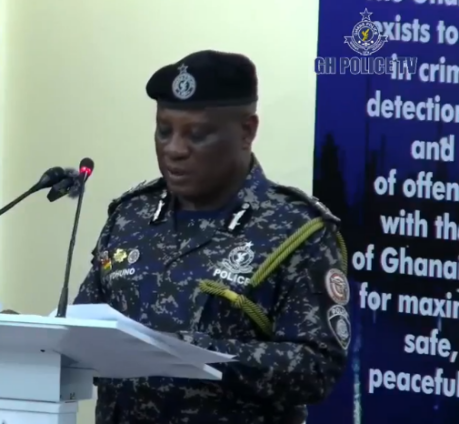
The President’s decision to proactively extend the tenure of Inspector-General of Police (IGP) Christian Tetteh Yohuno is not a betrayal of promise, but a courageous recognition that a greater principle, that of constitutional duty to ensure national stability, must, on rare occasions, override an administrative rule.
This move is less a U-turn and more a strategic pivot, demanded by the extraordinary performance of the IGP and the profound exigency of the current security landscape.
The argument against the extension rests on administrative chronology; the defence of the President’s action rests on irrefutable competence and critical timing.
The transition from former IGP Dampare to IGP Yohuno was not an abandonment of the principle of continuity, but an evolutionary step in the pursuit of institutional excellence and specialised readiness.
The President, in his capacity as Commander-in-Chief, has consistently demonstrated a commitment to placing the right leader with the right expertise at the right time.
The Dampare’s leadership initiated necessary reforms and brought a new vigour to police visibility, laying the groundwork for the modern police service. The global and regional threat environment, however, has fundamentally shifted toward intelligence-led warfare against transnational crime and terrorism.
IGP Yohuno, with his deep background as the first Director-General of Police Intelligence, was specifically chosen to elevate the fight from generalised crime management to sophisticated threat eradication.
His appointment was a strategic recalibration, not a rejection, recognising the nation needed a “Sentinel of Intelligence” to meet the new, complex challenge.
Ghana faces a complex and evolving security matrix that demands a steady, experienced hand at the apex of law enforcement. The national stability is not threatened by a single issue, but by persistent, interwoven perils: the surge of violent extremism and insurgency from the northern borders, coupled with established transit routes for drug and arms trafficking.
IGP Yohuno represents the only proven command structure capable of maintaining the necessary security bulwark against this encroachment.
To swap a Commander who has spent his career fortifying these defences for an untested successor would be an act of dangerous self-sabotage. The core of the President’s promise was to install a new brand of ethical, high-performance public service.
IGP Yohuno is actively delivering this, and his reforms are incomplete. His achievements are the necessary, visible foundations of a truly modern police service that cannot be abruptly abandoned.
The shift from reactive policing to proactive, intelligence-based interventions is a cultural revolution within the Service, requiring continuity under its architect to fully embed the new training and operational philosophy.
Furthermore, the sustained, high-level operation against illegal mining (galamsey), which is linked to corruption and environmental collapse, and against high-profile organised crime shows a spine and commitment that has been long absent.
To halt this momentum now, merely because a calendar dictates it, is to invite institutional relapse, the very thing the President promised to prevent. The promise to end extensions was meant to restore morale and open pathways for deserving junior officers.
However, the IGP position is not merely a retirement gift for a next-in-line; it is a solemn constitutional post demanding a confluence of rare skills, experience, and moral authority.
IGP Yohuno’s two-year extension is not a routine favour but a bespoke contract for a specific, critical national mission.
It sends a clearer, more powerful message to the service: Exceptional, non-partisan performance at the highest level will be rewarded and retained for the national good. This is an affirmation of true meritocracy, not its denial.
The President had a choice between two paths: the comfortable path of political consistency, which would have risked national security, or the difficult path of strategic inconsistency, which ensures national stability.
He chose the latter, demonstrating that responsible leadership sometimes requires the painful juxtaposition of stated principle against ultimate purpose.
In the case of IGP Christian Tetteh Yohuno, the national good demanded that the Sentinel’s Shield remain in the hand that has proven strongest to defend the Republic in its most fragile hour.
The extension is a mandate for continuity, a vote of confidence in competence, and the highest possible service to the Republic. The promise remains, but the preservation of peace is the higher calling.
By Raymond Ablorh, Policy, Research, Media and Strategic Communication Consultant
