

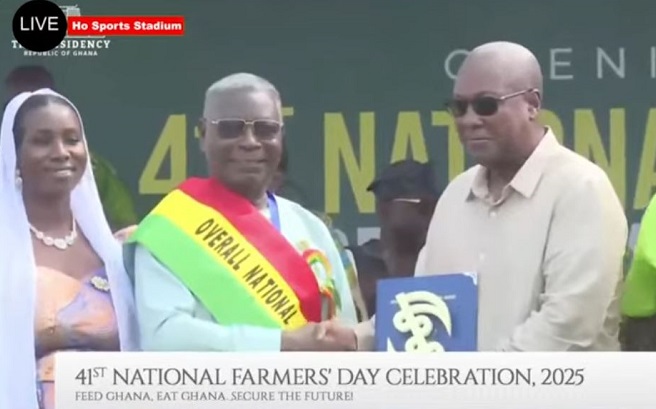

Ho, Volta Region, Ghana//-An 82-year-old farmer from the Kwahu Afram Plains South District of the Eastern Region, Opanyin Abraham Kwaku Adusei, has been crowned the Overall 2025 National Best Farmer.
Opanyin Adusei has been farming for 44 years and manages 1,000 acres of cocoa, 293 acres of mango, and 30 acres of cashew.
For his achievement, he received GH₵1.2 million sponsored by the Agricultural Development Bank, a brand-new tractor donated by Sino Trucks, power trailers, a motorised sprayer and a commemorative plaque.
Other winners were:
Osmanu Kadri – 1st Runner-Up, National Best Farmer (Greater Accra Region)
Charles Gyato – 2nd Runner-Up, National Best Farmer (Volta Region)
Grace Owusuaa – National Best Female Farmer (Ashanti Region)
Ruben Asare – National Best Youth Farmer (Bono East Region)
Agriculture isn’t only for village folks’
Speaking at the 41st National Farmers’ Day celebration in Ho on Friday, December 5, 2025, President John Dramani Mahama called on Ghanaians, particularly those in formal employment, to consider farming as an additional and reliable source of income, stressing that agriculture must no longer be seen as the preserve of rural communities.
The President said the evolving nature of modern agriculture makes it possible for teachers, civil servants, private sector employees and other professionals to successfully combine their regular jobs with farming.
“Agriculture isn’t only for the village folks,” President Mahama said. “You can work and still be a farmer. Teachers and civil servants can go to work and have farms, and the money from the farm can supplement their incomes.”
He explained that many of the challenges traditionally associated with farming have been eased by the increased availability of mechanisation services, improved seedlings, irrigation systems and digital tools that enable farmers to monitor productivity even when they are not physically present on their farms. These modern systems, he said, make part-time farming more feasible than ever.
The President emphasised that encouraging more professionals to participate in farming would not only improve household finances but also strengthen national food security and reduce Ghana’s dependence on imported produce. He restated his government’s commitment to creating a conducive environment that supports all categories of farmers, including those combining agriculture with full-time work.
Meanwhile, the Minister of Food and Agriculture, Eric Opoku, used the occasion to rally corporate Ghana to support national agricultural growth. Addressing the gathering in Ho, he said there was “a renewed national commitment” to strengthening the sector and urged companies to work with the Ministry to expand support for farmers. “I want to urge corporate Ghana to partner with the Ministry,” he said.
Mr Opoku also highlighted the rising importance of timely weather information in agricultural planning, noting that climate unpredictability has become one of the greatest risks facing farmers. “Agricultural success today depends not only on land and labour, but on timely and accurate weather information,” he said, referencing recent remarks he made during the Government Accountability Series Session.
He added that the Ministry has made significant progress in upgrading Ghana’s agro-meteorological systems to ensure farmers can access real-time data that improves decision-making and protects livelihoods.
This year’s Farmers’ Day celebration brought together farmers, agricultural workers, policymakers and development partners in recognition of the pivotal role the sector continues to play in Ghana’s economy. Both the President and the Agriculture Minister reaffirmed that the country’s development ambitions are closely tied to building a resilient, technology-driven and inclusive agricultural sector.
––pledges bold agricultural reforms
Mahama praised Ghana’s farmers and fishers as the backbone of national food security and economic stability.
He underscored the urgent need to reduce Ghana’s $3 billion annual food import bill by strengthening local production through a robust and well-sequenced agricultural transformation agenda.
Highlighting progress under the Feed Ghana programme, Mahama noted major improvements in irrigation expansion, mechanisation, storage capacity, credit access, and value-chain development.
He reported a significant drop in food inflation, from 28.3 per cent in January 2025 to 9.5 per cent in October 2025, attributing it to targeted interventions such as fertiliser and seed distribution and expanded irrigation infrastructure.
“Although investments have been made over the years, Ghana still spends close to $3 billion annually to import basic food commodities such as rice, poultry, vegetable oils, sugar and other processed foods. This situation is neither sustainable nor acceptable. It signals the urgency of building a bold and resilient agriculture framework, an agenda that my government is determined to vigorously pursue.
“The sustained transformation of the agriculture sector requires well-designed, comprehensive and sequenced interventions implemented with discipline and commitment,” he said.
The president outlined ongoing initiatives, including vegetable development projects, solar-powered boreholes, farmer service centres, mechanisation support, and strengthened buffer stock systems to prevent post-harvest losses
He insisted that government assistance will be directed through farmer cooperatives, urging farmers to organise themselves to benefit fully from national programmes.
President Mahama emphasised the need for Ghanaians to “Eat Ghana,” promoting local rice, poultry, vegetables, oils, and staples to achieve food sovereignty. He also highlighted renewed efforts to revive the poultry industry, the establishment of modern processing plants, and expanded partnerships with private processors.
“We are expanding irrigation infrastructure, establishing farmers’ service centres, increasing storage capacity, improving access to credits and insurance, and strengthening linkages in agro-processing. We’re also establishing economic enclaves, using public-private partnerships to facilitate large-scale agribusiness investments, while incorporating smallholder farmers into inclusive value chains,” he said.
“When my government assumed office in January 2025, food inflation stood at 28.3 per cent. Through targeted interventions and careful management of food systems, I’m pleased to report that food inflation has decreased significantly to 9.5 per cent by October 2025,” he stressed.
He called for climate-smart agriculture, stronger research collaboration, and deeper engagement with development partners such as IFAD, AGRA, GIZ, JICA, FAO, AFDB and others.
Overall, the president reaffirmed his government’s commitment to building a resilient, competitive agricultural sector capable of feeding the nation, creating jobs, and securing Ghana’s future.
“To feed Ghana, we must also eat Ghana. We cannot import what we can grow, and therefore we are promoting a strong natural culture of supporting Ghanaian rice, Ghanaian poultry, Ghanaian yams, fruits and vegetables, cooking oil, and cassava products.”
“This is essential if we are to achieve food sovereignty and agricultural profitability. Building a resilient agricultural sector requires climate-smart approaches, strong risk management systems, and investment in research, innovation, and agro-ecological practices. The government is therefore strengthening collaboration with our development partners, financial institutions, and the private sector to make agriculture a viable and attractive livelihood for future generations,” he added.
Minister urges farmers
Minister of Food and Agriculture, Eric Opoku, has stated that Ghana’s agricultural future depends on empowering farmers to take the lead across the entire agri-space.
He said farmers should not remain passive participants but must be positioned at the forefront of innovation, value-chain development and national food security efforts.
Speaking at the 41st National Farmers Day Celebration in Ho on Friday, December 5, the Minister also praised the resilience and ingenuity of farmers and fishers, noting that their work is central to Ghana’s economic transformation.
“Distinguished ladies and gentlemen, permit me to commend the hardworking farmers and fishers gathered here. Their innovation and resilience continue to inspire our work at the Ministry, whether through improved seed adoption, sustainable livestock practices, irrigation use, mechanisation, or agro-processing, to have proven that agriculture remains a powerful engine for building a robust, sustainable, and circular economy,” he said.
He credited close collaboration between the Ministry and research institutions for ensuring that policies are science-driven and impactful.
He also acknowledged major private-sector partners and sponsors—such as ADB, Glico, Stanbic Bank, and Sino Machinery—for demonstrating strong confidence in Ghana’s agricultural future.
He commended AgriHouse Foundation for successfully organising the National Agricultural Fair at no cost to the state, and celebrated the introduction of the Innovation, Research and Development Session, which showcased scientific breakthroughs from Ghana’s universities and research bodies.
“Over the past 11 months, the Ministry of Food and Agriculture has laid a solid foundation for agricultural transformation. All our actions have been informed by science, and we believe that collaboration between the research institutions and the Ministry of Food and Agriculture is indispensable for the achievement of food and nutrition security. As a ministry, we have worked tirelessly to advance the vision of agricultural transformation under the Feed Ghana programme,” he said.
“The program has begun delivering tangible results through expanded irrigation development, mechanisation support, seed and fertiliser distribution reforms, livestock improvement initiatives and strengthening value chain development. These interventions are not abstract policy ideas. They are transforming rural livelihoods, increasing productivity and creating opportunities for farmers, especially women and the youth.”
The Minister expressed confidence that with continued investment, Ghana can become the “food nation of Africa.”
“We are confident that with the establishment of the government’s research fund, this innovation will finally transition from the laboratory to the field, where farmers can benefit directly, and Ghana’s agricultural transformation can be accelerated.”
“We applaud all participating institutions for their leadership and commitment. Distinguished ladies and gentlemen, Ghana is endowed with enormous agricultural potential and with the right investment and determined leadership.”
He urged Corporate Ghana to deepen partnerships with the Ministry to help scale innovations, strengthen value chains, and empower farmers.
Concluding, he reaffirmed the government’s commitment to ensuring that farmers and fishers remain leaders of the agricultural space, and celebrated them for sustaining the nation and driving collective progress.
