

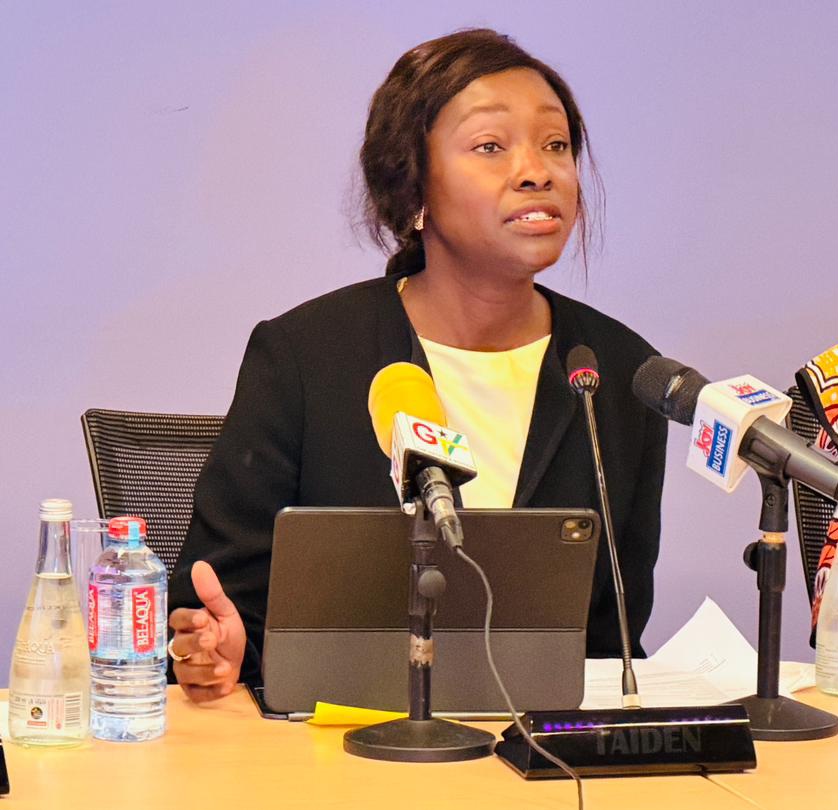

Accra, Ghana//-The newly appointed World Bank Group’s Regional Practice Director for Prosperity for West and Central Africa, Madam Seynabou Sakho, today revealed that Ghana’s trade potential remains under-realised.
The country which hosts the African Continental Free Trade Area (AfCFTA) Secretariat, according to her, could do so much more than it is doing now.
Madam Sakho made this known at a joint seminar series organised by the World Bank Group Ghana Country Office, the African Center for Economic Transformation (ACET), and the Institute of Statistical, Social and Economic Research (ISSER), Transformation Dialogues in Accra.
According to estimates from the International Trade Centre (ITC), Ghana has $12 billion of unrealised export potential, which is almost half of its current potential, which means that the country could double what it is doing right now.
“This points to a missing gap, and if you think about all the better jobs that could be generated through this gap, it is really a huge opportunity for the country right now”, she added.
Madam Sakho noted that closing this gap, of course, would require addressing a lot of gaps, including trade policy and trade facilitation constraints.
“But also making sure that we strengthen the broad production base, including diversifying to higher value-added goods and services and making sure that firmscano scale up, and to growis is why the question of what kind of policy agenda can help realize the benefit of trade for growth, productivity, and job creation and to fulfill this missing potential”, she told senior government officials, policymakers, researchers, academia, development partners, among others at the event.
The discussion she and other speakers are having takes place amid a context that they all know is characterised by volatility, uncertainty, wars, and lack of predictability in the current global economy.
Madam Sakho acknowledged that the current global trading system is becoming more and more uncertain and more fragmented. For instance, those of you who follow the meeting in Cameroon see how they ended up.
That means that while countries are rethinking supply chains, industry policy, food security, technology and market access, they still don’t have that platform to help them do it as a collective.
For countries like Ghana, this creates risk and also opportunity, and she went on to urge Ghana and other countries in the sub-region not to let the risk prevent them from seizing the opportunities.
So, this is a priority area for the World Bank Group, because trade expansion remains one of the most powerful channels for creating jobs. We all know that is the way to create more prosperous economies and create more and better jobs, she indicated.
Ghana, Madam Sakho noted, has the role, both in the region and beyond the continent. When you see how Ghana’s exports fare, it is a global country when it comes to trade.
“More than that, Ghana can also take advantage of the AfCFTA by building regional value chains, and strengthening progress in a more diversified export sector, including those related to digital services, agribusiness, light manufacturing and other higher valued exports.
We all know that one key aspect of Ghana’s development plan is to add value to the riches that Ghana is already endowed with”.
A recent World Bank analysis from its chief economist’s office shows why this matters. Because at this point, they know that intra-trade within Africa is so small in volume, but could be again an area of expansion and potential.
“While it is small. We know that. Intra-trade in Africa is more diversified and more manufacturing-intensive than what Africa exports to the rest of the world, which turns out to be raw materials and minerals, making it especially relevant for adding jobs, adding value, adding innovation, and creating industrial capabilities “.
Ghana is yet to reap its full trade benefits
In a presentation on the seminar theme- “Rethinking Trade for Growth and Jobs in Ghana”, Rami Galal, an Economist in the Finance, Competitiveness, and Innovation (FCI) Global Practice, at the World Bank, also disclosed that Ghana has a lot of trade potential, but it has not reaped its full benefits.
According to him, the causes for the country’s trade under-performance are cross-cutting constraints in trade policy and facilitation, alongside an undiversified production base.
For Ghana to unlock that potential, Mr Galal urged the authorities of the country to adopt an export-driven trade strategy, develop a more diversified production base, and relax sector-specific constraints.
Economic Growth
Tariff cuts, Non-Tariff Barrier (NTB) reductions, and trade facilitation could raise Ghana’s real income by 6% by 2035. Exports may grow 78% overall and 94% to AfCFTA partners, with imports rising 79%, he added.
Non-Tariff Barriers (NTBs) refer to restrictions that result from prohibitions, conditions, or specific market requirements that make importation or exportation of products difficult and/or costly.
While increased trade could drive job creation, especially for unskilled and female workers, lifting 200,000 people out of extreme poverty by 2035, he disclosed.
Opening the seminar, Ghana’s Minister of Trade, Agribusiness and Industry, Mrs Elizabeth Ofosu-Adjare, said today’s theme, ‘Rethinking Trade for Growth and Jobs in Ghana,’ is important as it underscores the fact that we have traded over the years but not captured the full benefits of trade.
Mahama’s vision for Ghana’s trade development
“This also resonates with President John Dramani Mahama’s vision for Ghana’s trade development, one centred on transforming the country from a raw material exporter into a self-reliant, import-substituting, and export-led economy through value addition, industrialisation, and aggressive export diversification”, she emphasised.
Ghana, Mrs Ofosu-Adjare explained, stands at a genuine inflexion point; one earned through difficult fiscal discipline and structural adjustment.
To have emerged from a national economic crisis into demonstrably restored macroeconomic stability within just sixteen months is a remarkable achievement.
It sets the foundation for resetting and rethinking the nation’s economic growth, sector by sector. The convening of this seminar today is precisely such a moment of reckoning, and of opportunity.
Trade statistics
In 2025, Ghana recorded a trade surplus of $13.6 billion, the strongest external trade performance in the country’s history.
Gross international reserves climbed to a record $13.8 billion, and our current account balance surged from $1.5 billion to over $9 billion in a single year.
These are products of deliberate reform and disciplined economic management. Behind that headline surplus is a breakdown worth examining, she said.
Additionally, total export receipts reached $31.11 billion, anchored by gold earnings that more than doubled to $20.98 billion, driven by increased volumes, higher global prices, and the reforms of the Ghana Gold Board that brought greater discipline and value retention to our gold trade.
Again, in 2025, Ghana’s non-traditional exports reached a record US$5 billion, a 30.7% surge on the previous year.
Within that figure, processed and semi-processed goods contributed $3.09 billion, up 52.78% from 2024. The single largest earner was cocoa derivatives: paste, butter, and powder.
These are proof that when we add value before we export, the returns follow. Impressive as these numbers are, they must be the beginning of a conversation, not the conclusion of one.
The country’s export base remains heavily concentrated on raw commodities. Stability has been earned, and it forms the platform from which we now build.
But a record surplus is a moment to be proud of, not a destination to settle in. The work of generational prosperity is still ahead of us.
That is the honest starting point for today’s conversation, and it is precisely why rethinking trade must be our strategic priority.
Trade transformation agenda
“Ghana’s trade transformation agenda under the Leadership of His Excellency John Dramani Mahama is firmly anchored in deliberate policy and decisive action.
The President of the Republic has been clear that the old model of exporting raw materials while importing finished goods is one Ghana can no longer accept”.
Nowhere is this more visible than in our approach to cocoa and gold, the two commodities that have defined Ghana’s export story for generations”.
Ghana has set a target to process at least 50 per cent of its cocoa domestically, and it has already installed grinding capacity of over 500,000 metric tonnes to back that ambition.
The same logic is being applied to gold. Ghana is Africa’s leading gold producer. The days of exporting unrefined bars while the refining margin is captured abroad are behind us.
Underpinning both is the 24-Hour Economy, designed to extend productivity, deepen value addition, and deliver the conditions for sustained, job-rich growth.
At the Ministry level, their work has been equally hands-on. They have engaged directly with Manufacturers, exporters, trade associations, and relevant stakeholders to address operational challenges and champion quality standards.
Without compliance, Ghanaian products cannot access premium markets, regardless of volume. And volume itself remains a challenge.
The minister maintained, “Our processing industries have consistently struggled with insufficient and irregular supply of quality raw materials, operating below capacity due to lack of reliable raw materials.
That is the structural gap Ghana is closing. The ban on the export of key raw materials is to ensure they feed our domestic industries first to be able to produce the volumes needed for both the local and export markets”.
Other speakers at the seminar, such as Presidential Advisor on the 24Hr Economy, Goosie Tanoh; Director of ISSER, Dr Robert Darko Osei; CEO of Business Outsourcing Services Association Ghana, David Gowu, and the Deputy Director of Ghana Export Promotion Authority (GEPA), Dr Martin Akogti, agreed that the country’s full potential in trade and export is yet to be fully achieved.
