

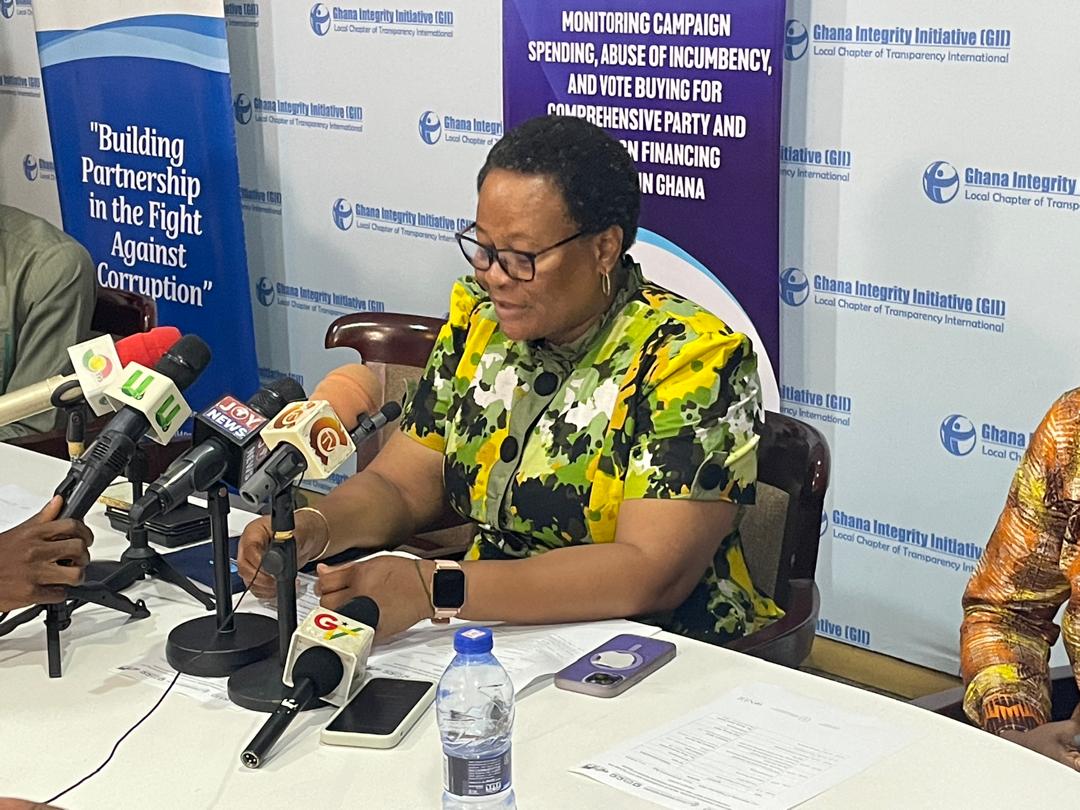

Accra, Ghana//-The Ghana Integrity Initiative (GII), Ghana Anti-Corruption Coalition (GACC), and the Ghana Centre for Democratic Development (CDD-Ghana), with funding support from USAID through the International Foundation for Electoral Systems (IFES) today, launched a three-month project to monitor campaign spending, abuse of incumbency and vote buying during the country’s December general elections.
The project titled “Monitoring Campaign Spending, Abuse of Incumbency, and Vote Buying for Comprehensive Party and Campaign Financing Reform in Ghana” will monitor campaign spending, track the abuse of incumbency, and document instances of vote buying during the 2024 presidential elections.
Why the project
Speaking at a media launch of the project in Accra, the Executive Director of Ghana Integrity Initiative, Mrs Mary Addah observed: “Ghana has long been recognised as a beacon of democracy in Africa. Increasingly this brand is threatened because our democracy has been monetised particularly in the realm of election financing and the abuse of state resources”.
She added that the influence of money on elections, the unchecked advantages of incumbency, and the harmful practice of vote buying not only undermine the integrity of the country’s elections but also erode the trust of citizens in our democratic institutions as captured in the Afrobarometer round 9 and other studies.
Women, the youth and the vulnerable are alienated from the space because of the excessive monetisation of our democracy. According to an assessment by the CDD and Westminster Foundation, average candidates needed to raise GH₵389,803 (approx. US$85,000) to secure the party primary nomination and compete in the parliamentary election in their constituency.
“The provisions governing political party financing in Ghana are contained in Chapter 7 of the 1992 Constitution (Article 55) and the Political Parties Act (Act 574). The legal frameworks make provision for private funding in Article 55 (15); donations to a political party registered in Ghana in Article 55 (15); Act 574, Section 23 and 24 and Disclosure and Reporting Obligations in Article 55 (14) and Act 574 1. 14. (1)”, Mrs Addah said.
Ghana’s campaign finance and political party funding laws have significant gaps. Current regulations do not provide for direct public funding of political parties, though past elections have seen the government allocate vehicles to parties through the Electoral Commission.
She explained that the law remains unclear on whether only natural persons, not companies, can make donations, yet it is common knowledge that businesses, including foreign entities, contribute to political parties. There is no limit on donations, and much of the funding Parliamentarians receive goes unaccounted for.
“While vote-buying is technically illegal, it is widely ignored, and no law prohibits the use of public resources for campaigns, leading to rampant abuse of incumbency. Additionally, disclosure laws do not require parties to identify their donors, and these regulations apply only to political parties, not individual candidates, undermining financial transparency in elections”.
Another worrying phenomenon is the abuse of state resources in Ghana’s political landscape. It manifests in various ways, from the use of government vehicles and public events for party purposes to the manipulation of state media and the improper use of security agencies.
These practices tip the electoral playing field, giving undue advantage to the incumbent while disenfranchising other political actors and, most importantly, the people of Ghana.
“In response to these challenges, our project will monitor campaign spending, track the abuse of incumbency, and document instances of vote buying during the 2024 presidential elections. This is not just an academic exercise – our findings will inform advocacy efforts aimed at promoting comprehensive party and campaign financing reforms in Ghana”, Mrs Addah said.
These reforms according to her are crucial for ensuring that the country’s democracy remains one in which elections are won based on ideas and policies, not on the weight of financial backing or incumbency advantage.
Touching on the project’s research methodology via Zoom, A Professor at the UK’s London School of Economics, George Ofosu said that the project’s objectives are twofold- estimate the Cost of Presidential Campaigns; and assess the extent of Abuse of State Resources (ASR).
Approach
He said the implementers of the project had adopted two key strategies namely, Campaign Finance Monitoring (CFM) to provide a systematic estimate of the cost of presidential campaigns, and ASR Monitoring estimate to what extent the incumbent party uses state resources to campaign.
He said the project being implemented by the three civil society organisations (CSOs) focuses on three major expenditure categories such as campaign events; campaign advertising in traditional media outlets; and advertising using billboards, posters, and banners.
Prof Ofosu explained campaign events to rallies, party meetings, keeping fit, social events (funerals, religious ceremonies, etc.), door-to-door campaigns, and meetings with business and civil society groups.
Data collection strategy
Survey instruments would be used to help them estimate the quantity of each campaign finance component (i.e., items). Another data collection strategy is desk research to find the unit cost of each of the items, and math to do the calculation to estimate cost, the lecturer said.
Prof Ofosu also added they would train and deploy two types of CFM experts for three months (6th September – 6th December 2024). They would deploy field (constituency) monitors to observe and report on campaign events and materials in selected constituencies for all presidential candidates.
Media monitors would be used to record advertising in print, radio, and television outlets for all presidential candidates, he added.
Constituency monitoring
In his words: “We combine purposive and random sampling strategies to pick 41 constituencies from the country’s 275
constituencies selected all the 18 constituencies located in the six Metropolitan Areas of Accra, Tema, Tamale, Cape Coast,
Sekondi-Takoradi and Kumasi randomly selected 23 constituencies from the remaining constituencies stratifying by region selected 30% (N ≈ 240) of electoral areas to monitor the presence of campaign materials.
Abuse of state resources
Strategy
In a nationally representative sample of constituencies, the team would capture instances of the use of state events, resources, and institutions (especially, security forces) for the incumbent party’s presidential candidate campaign.
Furthermore, they would estimate bias in coverage and reporting in state media outlets, state events, Metropolitan/Municipal/District Events, National events, campaign rallies, door-to-door campaigns in the constituency, Government Information Van making rounds, project sod-cutting or groundbreaking events and project commissioning or inauguration.
The three NGOs which are implementing the project will train and deploy two types of ASR experts for three months (6th September – 6th December 2024). There are field (constituency) monitors to observe and report on state events and institutional overreaches; and media monitors to record the frequency and nature of reporting on campaigns of all political parties.
ASR
The ASR component of the project is expected to cover 67 constituencies randomly selected from across the country using a stratified sampling method.
Report Dissemination and Public Engagement
The fundraising Manager at the GII, Michael Boadi said they would organize one-on-one meetings with policymakers and other key stakeholders to share the report findings and recommendations with them to help champion reforms to help reduce campaign spending, abuse of incumbency and vote buying in the country.
