

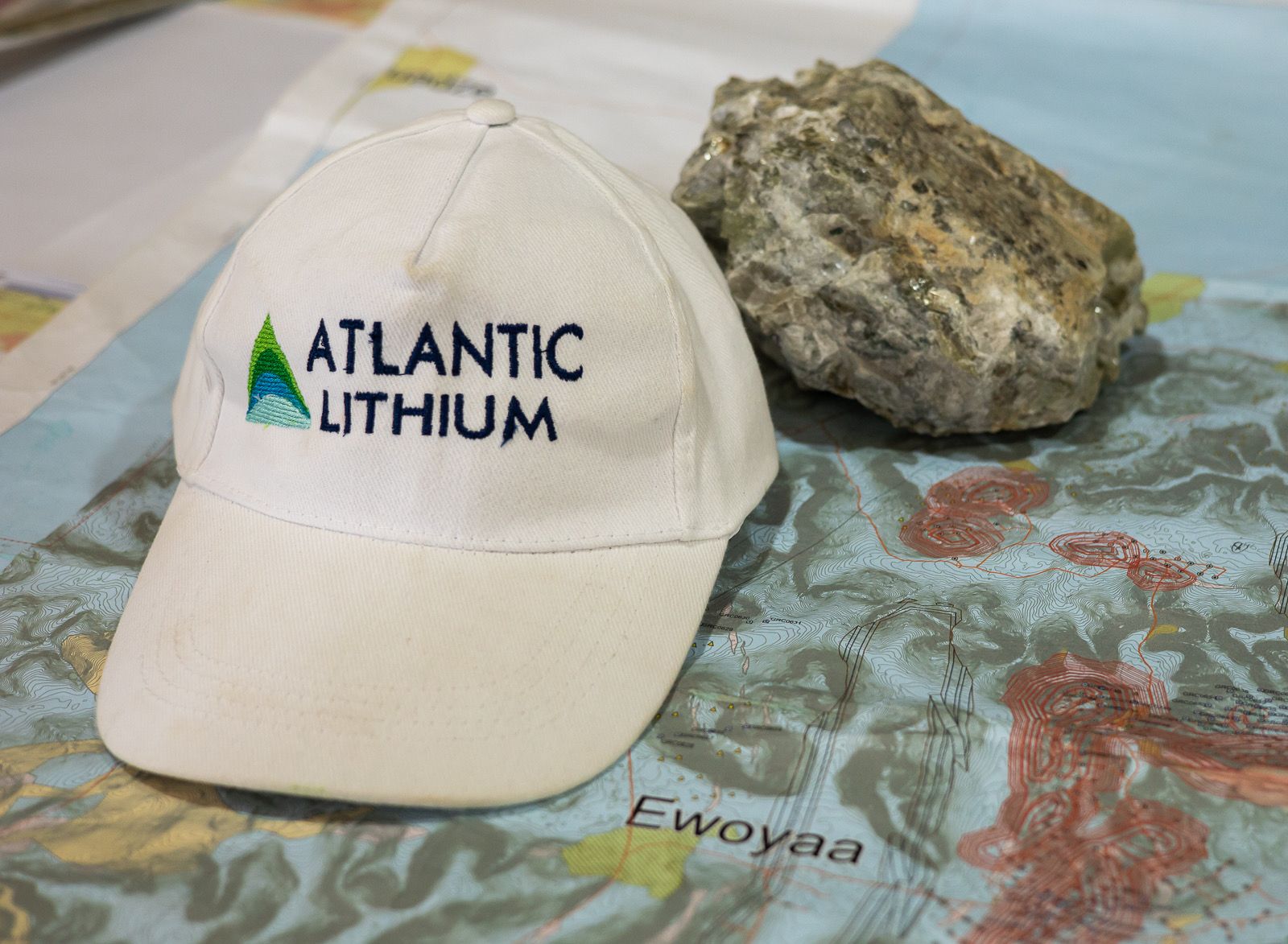

Atlantic Lithium Limited, the African-focused lithium exploration and development company targeting to deliver Ghana’s first lithium mine has announced an increase to the JORC (2012) compliant Mineral Resource Estimate (MRE) at the Company’s flagship Ewoyaa Lithium Project (”Ewoyaa” or the “Project”) in Ghana, West Africa.
Highlights
The total Mineral Resource Estimate for the Company’s flagship Ewoyaa Lithium Project increased to 36.8Mt at 1.24% Li2O, as reported by the JORC Code (2012).
– 81% of the Total Resource now in the higher confidence Measured and Indicated categories (3.7Mt at 1.37% in the Measured category, 26.1Mt at 1.24% in the Indicated category and 7.0Mt @ 1.15% Li₂O in the Inferred category).
– MRE increase follows the targeted drilling programme, undertaken in 2023 and H1 2024, comprising sterilisation drilling to support the plant and haul road design and resource conversion drilling, converting Inferred resources to Indicated and Measured resources, to provide mine plan optionality; new Dog-Leg target identified through this process.
– Drilling was subsequently undertaken on the Dog-Leg target, where the Company has identified a shallow-dipping, near-surface mineralised pegmatite body with true thickness up to 35m, which contributed 890,892 tonnes of the Resource increase to 36.8Mt at 1.24% Li2O.
– Potential to grow the Resource further; step-out drilling planned at five priority deposits and one new exploration target identified for initial reverse circulation (“RC”) evaluation.
Commenting, Neil Herbert, Executive Chairman of Atlantic Lithium, said: “We are pleased to report an increase in the Mineral Resource for the Ewoyaa Lithium Project to 36.8Mt at 1.24% Li2O, which reaffirms Ewoyaa’s status as one of the leading hard rock lithium projects.
“The increase follows the limited drilling programme completed recently, which was focused on supporting our mine planning activities rather than expanding the resource base, but through which we identified the Dog-Leg target, which has added near-surface tonnes to the Ewoyaa Resource.
We are pleased to see this lucky strike at DogLeg contributing an additional circa 891,000 tonnes to the enlarged 36.8Mt at 1.24% Li2O Resource. “While our current focus remains firmly on advancing Ewoyaa towards shovel-readiness, we recognise the significant potential across our exploration portfolio to increase the Resource further.”
Mineral Resource Estimate Upgrade
An upgraded MRE of 36.8Mt at 1.24% Li2O was completed for the Ewoyaa deposit and surrounding pegmatites; collectively termed the “Ewoyaa Lithium Project”. The MRE increase follows a targeted drilling programme aimed at supporting the mine-build activities at the Project.
This comprised sterilisation drilling to support the plant and haul road design and resource conversion drilling, aimed at converting Inferred resources to Indicated and Measured, to provide mine plan optionality. The drilling programme resulted in the combined Measured and Indicated resource increasing to 81% of the Total Mineral Resource (to 29.8 Mt at 1.26% Li2O).
During the drilling programme, the Dog-Leg target was identified, with prioritised drilling subsequently undertaken, which returned multiple broad and high-grade intersections, from which the Company has identified a shallow-dipping, near surface mineralised pegmatite body with true thickness up to 35m.
The Dog-Leg target contributed 890,892 tonnes, comprising 332,100 tonnes at 1.01% Li2O Indicated and 558,792 tonnes at 1.13% Li2O Inferred, of the increase in resources to 36.8Mt at 1.24% Li2O.
The Mineral Resource is based on 168,015m of drilling completed at the Project to date, inclusive of infill and extensional drilling undertaken since the February 2023 MRE reported by the Company, comprising 148,865m of reverse circulation (“RC”), 12,639m of diamond core (“DD”), 5,311m of reverse circulation with diamond tail (“RCD”) and 1,200m of reverse circulation hydrology holes (“RCH”).
The MRE includes a total of 3.7Mt at 1.37% Li2O in the Measured category, 26.1Mt at 1.24% Li2O in the Indicated category and 7.0Mt at 1.15% Li2O in the Inferred category (refer Table 1).
The independent MRE for Ewoyaa was completed by Ashmore Advisory Pty Ltd (“Ashmore”) of Perth, Western Australia, with results tabulated in the Statement of Mineral Resources in Table 1.
The Statement of Mineral Resources is reported in line with the requirements of the JORC Code (2012) and is therefore suitable for public reporting. High-level Whittle optimisation was completed and demonstrates reasonable prospects for eventual economic extraction.
Geology and Geological Interpretation
The Project area lies within the Birimian Supergroup, a Proterozoic volcano-sedimentary basin located in Western Ghana. The Project area is underlain by three forms of metamorphosed schist; mica schist, staurolite schist and garnet schist.
Several granitoids intrude the basin metasediments as small plugs. These granitoids range in composition from intermediate granodiorite (often medium-grained) to felsic leucogranites (coarse to pegmatoidal grain size), sometimes in close association with pegmatite veins and bodies.
Pegmatite intrusions generally occur as sub-vertical dykes with two dominant trends: either east-northeast (Abonko, Asan, Kaampakrom and Ewoyaa Northeast) dipping sub-vertically northeast; or north-northeast (Ewoyaa Main) and dip sub-vertically to moderately southeast to east-southeast.
Pegmatite thickness varies across the Project, with thinner mineralised units intersected at Abonko and Kaampakrom between 4 and 12m; and thicker units intersected at Ewoyaa Main between 30 and 60m, and up to 100m at the surface. The Project area has two clearly defined material types of spodumene-bearing lithium mineralisation.
The Company has termed these material types as Pegmatite Type 1 (“P1”) and Pegmatite Type 2 (“P2”). P1 material is characterised by coarse-grained spodumene-bearing pegmatite which exhibits very coarse to pegmatoidal, euhedral to subhedral spodumene crystals.
P2 material consists of medium-grained spodumene, euhedral to subhedral in shape and can compose up to 50% of the rock. The two material types have different metallurgical recoveries. Drill Methods The database contains data for the drilling conducted by the Company since 2018, with an overview of drill types shown in Figure 6.
Drilling at the deposit extends to a maximum drill depth of 386m and the mineralisation was modelled from surface to a depth of approximately 380m below surface.
The estimate is based on good quality reverse circulation (“RC”) and diamond core (“DD”) drilling data. Drill hole spacing is as close as 20m by 15m in some portions of the Ewoyaa deposit; then spacing is predominantly 40m by 40m across the Project and up to 80m by 80m in parts of lesser-known mineralisation.
The RC drilling used a combination of 5.25’ and 5.75’, face sampling hammers. The DD used PQ and HQ (resulting in 85mm and 63.5mm diameter core respectively) diameter core barrels.
The DD holes were completed from the surface with PQ to maximise recovery in weathered zones, with reversion to HQ once ground conditions improved within fresh material. In 2018, Phase 1 RC holes were completed on a nominal 100m by 50m grid pattern, targeting the Ewoyaa Main mineralised system.
Phases 2 to 5 reduced the wide spacing to 80m by 40m and down to 40m by 40m in the well-drilled portions of the Project. Phase 5 was a major infill drilling program down to 40m by 40m over most of the Project.
Phases 6 and 7 included extensional drilling in areas of open mineralisation, as well as close-spaced infill drilling in portions of the Ewoyaa deposit. A summary of the drilling data within the Ewoyaa Lithium Project Mineral Resource area is shown in Table 4.
Sampling Methodology
During Phase 1 and 2, RC drilling bulk samples and splits were collected at the rig for every metre interval drilled, the splits being undertaken using a riffle splitter. Since Phase 3, RC samples were split with a rig-mounted cone spitter which took duplicate samples for quality control purposes.
Diamond core was cut with a core saw and selected half core samples totalling 2,131.1kg were dispatched to Nagrom Laboratory in Australia for preliminary metallurgical test work.
Selected core intervals were cut to the quarter core with a saw at one-metre intervals or to geological contacts; and since December 2018 were sent to Intertek Laboratory in Tarkwa for sample preparation.
Before that, samples were sent to the SGS Laboratory in Tarkwa for sample preparation. Sample Preparation Since December 2018, samples were submitted to Intertek Tarkwa (SP02/SP12) for sample preparation.
Samples were weighed, dried and crushed to -2mm in a Boyd crusher with an 800-1,200g rotary split, producing a nominal 1,500g split crushed sample, which was subsequently pulverised in an LM2 ring mill.
Samples were pulverised to a nominal 85% passing 75µm. All the preparation equipment was flushed with barren material before the commencement of the job. Coarse reject material was kept in the original bag.
Lab sizing analysis was undertaken on a nominal 1:25 basis. Final pulverised samples (20g) were airfreighted to Intertek in Perth for assaying. Before December 2018, all Phase 1 samples were submitted to SGS Tarkwa for preparation (PRP100) and subsequently forwarded to SGS Johannesburg and later to SGS Vancouver for analysis (ICP90A).
Sample Analysis Method
Since December 2018, samples were sent to Intertek Laboratory in Perth for analysis (FP6/MS/OES). FP6/MS/OES is an analysis of lithium and a suite of 21 other elements. Detection limits for lithium range between 5ppm and 20,000ppm.
The sodium peroxide fusion (in nickel crucibles) is completed with hydrochloric acid to dissolve the sub-sample and is considered a total dissolution.
Analysis is conducted by Inductively Coupled Plasma Mass Spectrometry (“ICP-MS”). Before December 2018, Phase 1 samples were submitted to SGS Johannesburg and later to SGS Vancouver for analysis (ICP90A).
ICP90 is a 28-element combination Na2O2 fusion with ICP-OES. ICP-MS was added to some submissions for additional trace element characterisation purposes.
All phase 1 SGS pulps were subsequently sent to Intertek Laboratory Perth for re-analysis (FP6/MS/OES) and included in the resource estimate.
Mineral Resource Classification
The Project deposits show good continuity of the main mineralised units which allowed the drill hole intersections to be modelled into coherent, geologically robust domains.
Consistency is evident in the thickness of the structure, and the distribution of grade appears to be reasonable along and across the strike. The Mineral Resource was classified as Measured, Indicated and Inferred Mineral Resource based on data quality, sample spacing, and lode continuity.
The Measured Mineral Resource was confined to fresh rock within areas drilled at 20m by 15m along with robust continuity of geology and Li2O grade. The Indicated Mineral Resource was defined within areas of close-spaced drilling of less than 40m by 40m, and where the continuity and predictability of the lode positions were good. In addition, Indicated Mineral Resource was classified in weathered rock overlying fresh Measured Mineral Resource.
The Inferred Mineral Resource was assigned to transitional material, areas where drill hole spacing was greater than 40m by 40m, where small, isolated pods of mineralisation occur outside the main mineralised zones, and to geologically complex zones.
The block model has an attribute “class” for all blocks within the mineralisation wireframes coded as either “mes” for Measured, “ind” for Indicated “inf” for Inferred. The Mineral Resource classification is shown in Figure 7 and Figure 8.
The extrapolation of the lodes along strike and down-dip has been limited to distances of 40m. Zones of extrapolation are classified as Inferred Mineral Resources.
The JORC Code (2012) describes several criteria which must be addressed in the documentation of Mineral Resource estimates before public release of the information. The criteria provide a means of assessing whether or not parts of the entire data inventory used in the estimate are adequate for that purpose.
The Mineral Resources stated in this document are based on the criteria set out in Table 1 of that Code. These criteria are listed in Appendix 1 and Appendix 2. Cut-off Grade The Statement of Mineral Resources has been constrained by the mineralisation solids, reported above a cut-off grade of 0.5% Li2O.
Whittle optimisations demonstrate reasonable prospects for eventual economic extraction. Estimation Methodology A Surpac block model was created to encompass the extent of the known mineralisation, including an additional block model for the Asan prospect.
The block model was rotated on a bearing of 30°, with block dimensions of 10m NS by 10m EW by 5m vertical with sub-cells of 2.5m by 2.5m by 1.25m. The block model was estimated using Ordinary Kriging (“OK”) grade interpolation.
The mineralisation was constrained by pegmatite geology wireframes and internal lithium-bearing mineralisation wireframes prepared using a nominal 0.4% Li2O cut-off grade and a minimum down-hole length of 3m. The wireframes were used as hard boundaries for the interpolation.
Bulk densities ranging between 1.7t/m3 and 2.78t/m3 were assigned in the block model dependent on lithology, mineralisation and weathering.
These densities were applied based on 14,046 bulk density measurements conducted by the Company on 101 DD holes and 35 RC holes with diamond tails conducted across the breadth of the Project. The measurements were separated using weathering surfaces, geology and mineralisation solids, with averages assigned in the block model.
