

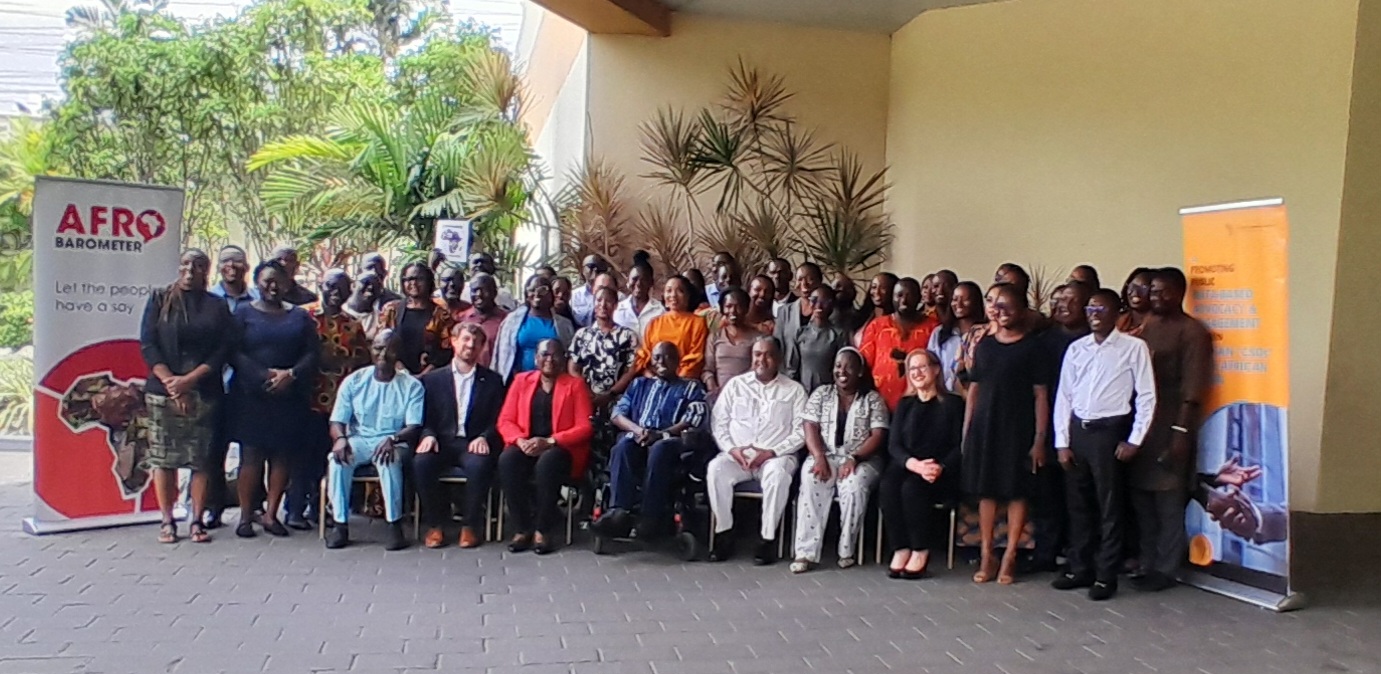
Accra, Ghana//-A four-day Data for Governance Alliance Continental Convening 2026 is underway in Accra to review the progress made under the various objectives of the Data for Governance Alliance (D4GA) program.
The program, which includes capacity building in data analysis, data usage in advocacy, data communication to policy actors, and Civil Society Organisations and African Union (CSO/AU) organs’ collaboration.
The Convening opened today would also reflect on, share experiences, and strengthen their shared commitment to realising the vision enshrined in Agenda 2063, which is the African Union’s 50-year master plan (2013–2063) for transforming Africa into a global powerhouse through sustainable development, integration, and unity.
In his opening address, Senior Advisor, Afrobarometer, Prof. E. Gyimah-Boadi said: “This event marks an important milestone in the journey Afrobarometer and the Alliance have been taking over the past four years”.
It has brought together, under one roof, key partners collaborating to create a comprehensive ecosystem to drive African governance and sustainable development — from data collection to advocacy to policy influence.
Your presence at this first-ever continental convening of the Alliance here in Accra — from across Africa and from our partner institutions beyond Africa — speaks to the shared belief that drives this Alliance: that data in the hands of African civil society is a powerful instrument for change.
As many in this room would appreciate, civil society has long been the connective tissue of Africa’s democratic journey.
In its best form, civil society is the space where citizens organise, deliberate, and hold power to account between elections, he added.
“From the pro-democracy movements that toppled authoritarian regimes in the 1990s to today’s youth-led campaigns against corruption, shrinking civic space, and electoral manipulation, civil society organisations have consistently expanded the frontiers of freedom and accountability in our countries”.
Prof Gyimah-Boadi noted that in a moment when democratic backsliding, disinformation, and authoritarian resurgence threaten hard-won gains, the role of civil society, and of the D4GA, is not merely important — it is indispensable.
Strengthening this sector, specifically its space and organisations that inhabit it, is, in every meaningful sense, an investment in the future of African democratic governance itself, according to him.
What is the Data for Governance Alliance (D4GA)
He explained that Africa’s continental governance architecture, anchored in the African Union’s Agenda 2063 and the African Governance Platform, articulates an ambitious vision of a people-centred, prosperous, and peaceful continent.
But that vision is only as strong as the citizens and civil society organisations who engage with it and hold governments accountable to it.
The Data for Governance Alliance was born out of the clear and pressing need to address three critical gaps standing in the way of achieving the goals set under Agenda 2063:
- Limited citizen awareness of Agenda 2063
- Insufficient access to citizen-generated data for civil society organisations, and
- Persistent challenges in tracking the implementation of the African Governance Platform’s commitments.
By making quality data accessible, meaningful, and actionable, D4GA has sought to bridge the distance between what African citizens experience and what African institutions decide.
The Alliance’s five distinguished consortium members
With Afrobarometer as the lead institution, the Alliance comprises the Institute for Development Studies at the University of Nairobi, the Institute for Justice and Reconciliation, the Ghana Center for Democratic Development, and Law Africa.
The Alliance spans East, Southern, and West Africa, and covers the breadth of our continent with purpose and resolve, Prof Gyimah-Boadi said.
Gratitude to funding partners
He used the occasion to express sincere gratitude to their funding partners of the D4GA.
“To the European Union, whose vision and support enabled D4GA to take root and flourish over four transformative years — thank you. Our thanks and appreciation go to the German Development Cooperation (BMZ), GIZ, the European Union, and also the German Embassy in Accra, whose support has made this continental convening possible”.
Prof Gyimah-Boadi also thanked the African Union institutions, the Government of Ghana, and every civil society organisation represented in this room for their partnership and their trust.
Deputy Head of the EU Delegation to the African Union, Mrs Stanghed Karin, who spoke via video, said that in 2025, the EU and the AU marked the EU-AU partnership on that occasion, they set an EU-AU Summit at the level of Heads of State and Governments to share experiences and ideas for the benefit of the two unions.
She reminded the participants drawn from AU countries that the EU-AU partnership constitutes the greatest gathering of leaders after the United Nations General Assembly.
Mrs Karin noted that, “in Rwanda, our respective leaders committed to further re-enforce multilateralism, agreeing on strong linkages between governments, peace and security.
Indeed, in the current geopolitical context is more crucial than ever for the two unions to invest in multilateralism, social justice, inclusive governance, peace, stability, and our strong commitment to international best practices and the rule of law”.
Delivering his keynote address, Head of the African Governance Architecture Secretariat, Ambassador Salah Hammad, said Africans and their governments were yet to learn anything from the COVID-19 era.
He added that the ongoing Russia-Ukraine war is exposing how Africa’s food system is very weak, lamenting that because of the war in Ukraine, Africa is almost starving. Many African citizens are affected by the war in Ukraine, which is thousands of kilometres away from the African continent.
In a speech read for the Ambassador of the Embassy of the Federal Republic of Germany to Ghana, Ambassador Frederik Landshöft, said it was encouraging to see how partnerships had been built to create the platform that brought a wide range of institutions, civil society organisations and international partners to champion the cause of data for all.
“We are meeting at a time when, on the one hand, the question of democratic government and institutional trust and accountability is becoming more complex across the world. And on the other hand, expectations from citizens appear to be rising in terms of transparency, participation and responsiveness of our institutions”, he noted.
